7 YouTube Ads Mistakes That Waste Your Budget (And What to Do Instead)

7 YouTube Ads Mistakes That Are Killing Your Channel Growth (And What to Do Instead)
About 25% of YouTube ad spend goes toward activity that looks productive in the dashboard but does nothing for your channel. That stat should not surprise anyone who has watched a channel throw £10,000 at a paid campaign and walk away with nothing but a spike in impressions and a subscriber count that barely moved.
The mistakes are not complicated. They are the same seven showing up across every channel size, genre, and budget. Most of them are fixable in an afternoon.
1. Pulling the plug before the campaign has even started
This one costs more than any other mistake on this list because it does not feel like a mistake. It feels like being responsible.
YouTube's reporting lags by days, not hours. The first 48 to 72 hours of a campaign will almost always look worse than reality. View-through conversions have not finished attributing. Budget pacing has not stabilised. YouTube averages spend over a longer window than Meta, so campaigns often underspend for days before ramping up to full pace.
If you have spent years running Meta campaigns, this is disorienting. On Meta you can read performance signals within hours and make decisions. Applying that same logic to YouTube means killing campaigns that had not started delivering yet.
Give it 7 to 14 days minimum. If subscriber acquisition cost is catastrophically bad after a full week, not slightly worse than expected but actually catastrophic, then reconsider. Otherwise let the platform learn.
2. Running paid to a channel that looks abandoned
Your YouTube channel is the landing page for your YouTube ads. Say that out loud until it stops sounding obvious, because most channels ignore it completely.
Someone watches your ad. They like what they see. They click through to your channel. What do they find? If the answer is three videos from 2022, an inconsistent thumbnail style, and a channel description that reads like it was written in five minutes, they leave. Research confirms exactly this: users landing on channels with no recent organic content showed near zero meaningful subscriber conversion. Not low. Near zero.
No amount of ad spend fixes a channel that looks like nobody is home. The organic house has to be in order before you turn on paid. Consistent publishing, branded thumbnails, and a clear channel identity changes the dynamic entirely.
3. Targeting everyone interested in your topic and calling it strategy
YouTube's targeting is genuinely powerful. Most channels barely scratch the surface.
Custom intent audiences let you reach people who searched specific terms on Google in the past seven days. In-market segments reach people actively researching content like yours right now. Remarketing lists catch people who have already visited your website or watched your videos. These are precise, high-intent tools.
What most channels actually do is target broad interest categories and then wonder why CPV is high and subscriber growth is low. There is a world of difference between targeting someone who searched for content in your exact niche last week and targeting someone loosely tagged as interested in your general category. One is actively looking for what you make. The other once watched something tangentially related.
Tighter targeting costs more per view. It also wastes dramatically less because nearly every view goes to someone who might actually subscribe and watch more.
4. Picking the wrong format for the wrong goal
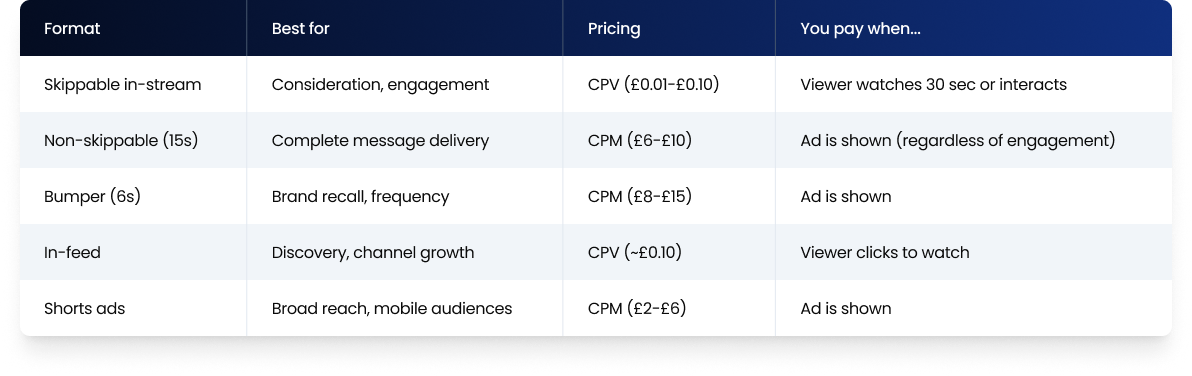
Running skippable in-stream ads when the goal is channel awareness wastes money. Bumpers are cheaper and guarantee full views for brand recall. Running bumpers when the goal is driving subscribers also wastes money because a six second ad gives nobody enough time to decide they want more of your content.
The format and objective mismatch is one of those mistakes that is invisible unless you know to look for it. A campaign can be performing on paper, hitting CPM targets, racking up views, while systematically failing to grow your channel because the format was wrong from day one.
For channel growth, skippable in-stream ads targeting custom intent audiences with a clear subscribe CTA will outperform every other format. For content discovery on mobile, Shorts ads reach broad audiences at low CPM. Match the format to what you are actually trying to achieve.
5. Treating creative as an afterthought
YouTube's auction system rewards engaging ads with lower costs and better placement. A well-made ad targeting the right audience can cost £0.02 per view. A lazy ad targeting the same people costs £0.08. Over 100,000 views that is £2,000 versus £8,000 for reaching the exact same audience.
Same audience. Same targeting. Same bidding strategy. Four times the cost difference purely because of creative quality.
The platform subsidises ads that keep people watching because that is how YouTube makes money. If your ad makes viewers skip immediately, you pay a premium for the privilege of annoying people. Most channels pour energy into targeting optimisation while running the same generic creative for months. Flip it. Creative is the single biggest lever on cost efficiency and most campaigns barely touch it.
6. Optimising for views instead of channel growth
A campaign with 500,000 impressions and a £4 CPM looks great in a dashboard. But if none of those viewers subscribed, watched another video, or took any action that signals genuine interest to the algorithm, you have spent money on people looking at your ad and doing nothing about it.
Views and impressions are visible. They are also nearly meaningless on their own for a channel trying to grow.
Watch time, average view duration, subscriber conversion rate, and click-through rate are the metrics that actually tell you whether paid spend is building something. Set up conversion tracking before launch. Not after. Not when you have enough data. Before. Campaigns without conversion tracking are campaigns without accountability.
7. Producing one polished ad and hoping for the best
The budget for one polished 30 second ad could fund ten YouTube creative tests. Each test teaches you something real about what your audience responds to. The single polished ad teaches you whether you liked the script.
YouTube advertising rewards iteration. Multiple creative variations tested against specific audience segments, with real performance data telling you which combinations to scale and which to cut. The channels that test fast and adapt beat the ones that spend months producing a single ad every time.
Something that looks rough but keeps people watching will outperform something expensive that gets skipped. YouTube is not TV. Production values matter less than the first five seconds. If those five seconds do not give someone a reason to keep watching, the remaining 25 seconds of brilliant content never get seen.
FAQ
Why are my YouTube ads not getting views?
Three usual causes: targeting too narrow (audience pool too small), bid too low for the competition in your space, or creative not compelling enough to win impressions in the auction. Check view rate first. Below 20% means the creative needs work. If view rate is healthy but volume is low, expand targeting or increase your bid.
How long should you run a YouTube ad before judging results?
At least 7-14 days. YouTube's attribution lags behind real-time, and budget pacing takes several days to stabilise. Campaigns that look weak after 48 hours often improve significantly once the platform has enough data to optimise delivery. Making kill decisions in the first two days is the most expensive mistake in YouTube advertising.
Do YouTube ads have to be 30 seconds?
No. Skippable in-stream ads can be any length, though you only pay if someone watches 30 seconds or the full ad if shorter. Non-skippable ads run up to 15 seconds on standard YouTube, with 30 and 60-second options rolling out for YouTube TV. Bumper ads are capped at 6 seconds.
What is a good view rate for YouTube ads?
The average is about 31.9%. Below 25% means your creative or targeting needs attention. Above 40% is strong performance. View rate is the closest thing YouTube ads have to a quality score, and it directly affects what you pay per view.
Is it worth paying for YouTube ads?
Yes, if you match format to objective, produce decent creative, and track conversions properly. 75% of businesses that advertise on YouTube report positive ROI. The 25% that don't typically share these same mistakes: broad targeting, weak creative, short campaign windows, and no conversion tracking.
How much budget do you need to test YouTube ads?
£300-£500 a month is enough for meaningful tests. Spend £15-£20 per day across 3-4 creative variations and 2-3 audience segments for two weeks. That gives you enough data to identify what works before committing larger budget. Scaling before you've tested is the second most expensive mistake after killing campaigns too early.
Wasting budget on YouTube ads you're not sure about?
If you liked that why not take a look

Copyright Claims vs Strikes: What Brands and Broadcasters Need to Know
Copyright claims and strikes are not the same thing. What each does to your channel, when to dispute, and how brands manage copyright risk at scale.
YouTube Content ID Explained: How Rights Holders Protect and Monetise Their IP
What YouTube Content ID is, who gets access, and how rights holders use it to protect and monetise content. Payouts, policies and pitfalls explained.
What Security and Compliance Should a YouTube Agency Have?
Your agency holds your accounts and data. What SOC 2, ISO 27001, GDPR and Cyber Essentials actually mean, and what to ask before you sign.
Should Your YouTube Agency Work With Your Competitors?
Your agency might run your rival's channel too. Why agency conflict of interest matters, how good agencies keep competing clients apart, and what to ask.
What Should a YouTube Agency Put in Writing?
Most YouTube agencies dodge written commitments. What a good agency should promise: response times, reporting cadence, and fixing underperforming videos.
What Data Can You Take When You Leave a YouTube Agency?
Can you take your analytics, dashboards and custom reports when you leave a YouTube agency? What data is yours, what is not, and how to avoid lock-in.

Ready to maximise your YouTube revenue?
Get in touch and let’s begin exploring your channel’s hidden potential.