YouTube SEO, AEO & GEO in 2026: What Actually Works Now

YouTube SEO, AEO & GEO in 2026
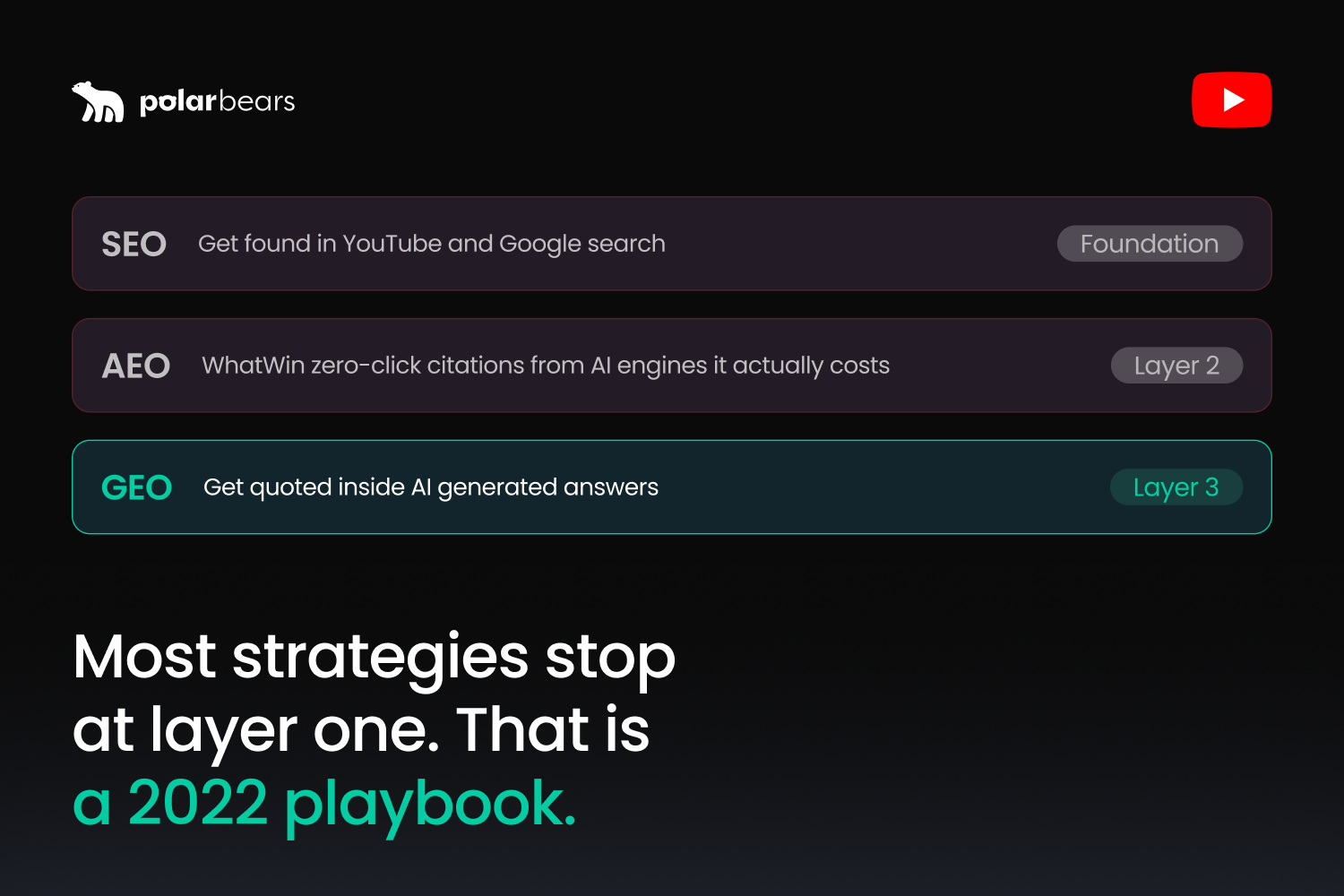
In 2026, ranking on YouTube means optimising for three layers, not one. Traditional SEO gets you found in YouTube and Google search. AEO (Answer Engine Optimisation) wins zero-click citations from ChatGPT, Perplexity, Gemini, and Google AI Overviews. GEO (Generative Engine Optimisation) gets your videos quoted inside generated answers. The brands and creators winning right now work all three together: semantic transcripts, structured schema, and content that's quotable by both algorithms and AI.
The shift is sharper than most people realise. Independent maker Pieter Levels reported AI referrals jumping from roughly 4% to over 20% of his traffic in a single month, and the same pattern is now showing up in how people discover video. If your strategy still ends at ranking in YouTube search, you're playing a 2022 game in a 2026 market.
SEO vs AEO vs GEO on YouTube: The Differences
The three disciplines share DNA but solve different problems.
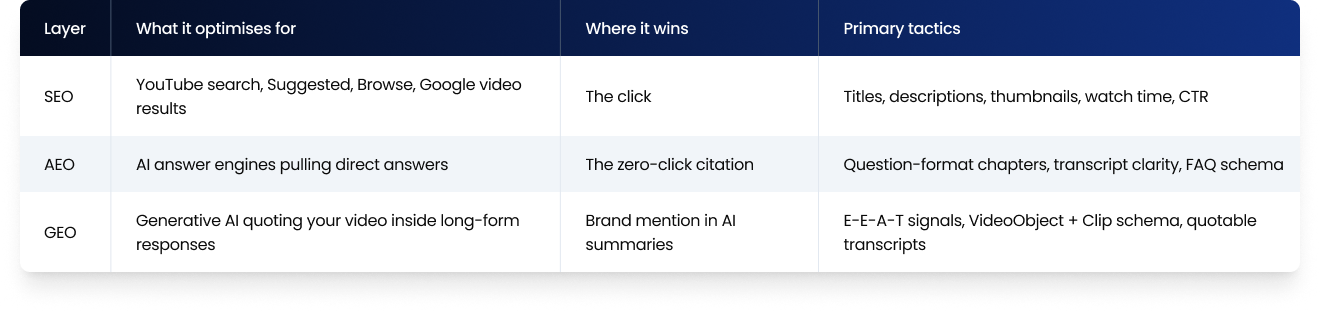
SEO is still the foundation. Without watch time and CTR, nothing else compounds. AEO layers on top: the same video, restructured so AI can extract a clean answer from one chapter. GEO is the longest game, where domain authority, transcripts, and structured data combine to make your video the source AI engines reach for.
YouTube Ranking Factors That Matter in 2026
YouTube's ranking system has consolidated around viewer satisfaction. Neal Mohan's 2026 creator letter and recent updates from Creator Insider confirm what the data already showed: the platform rewards videos that hold attention and trigger return visits, not videos that simply attract clicks.
The signals carrying the most weight right now:
1. Click-through rate (CTR), measured against impressions in the home feed and search results
2. Average view duration (AVD) and audience retention percentage
3. Session duration, which tracks whether your video keeps viewers on YouTube afterward
4. Returning viewer ratio, which signals long-term audience trust
5. Early engagement, especially likes, comments, and shares within the first hour
6. Semantic relevance from titles, transcripts, captions, and chapter markers
7. Freshness, particularly for trending or news-adjacent topics
Tag stuffing is dead. YouTube's own help documentation describes tags as a tool for disambiguating misspelt or unusual niche terms — not a meaningful ranking lever. Exact-match keyword titles no longer carry the weight they did in 2023. The platform now reads transcripts and chapters semantically, which means natural language outperforms forced phrasing.
A healthy CTR in 2026 sits between 4% and 10%, with the range tightening by niche. According to vidIQ benchmark data, education and finance often land in the 6-9% bracket. Gaming and entertainment can run higher. AVP (average percentage viewed) above 50% is strong for long-form, with 70% and above expected on Shorts.
How AEO Works for YouTube Video
When ChatGPT, Perplexity, Gemini, or Google AI Overviews answer a question with video, they almost never embed the whole thing. They pull a transcript chunk, a chapter, or a clip. That citation behaviour shapes how a video needs to be structured if you want to be the source.
The mechanics are consistent across engines:
The AI parses the transcript first, looking for a clean, self-contained answer to the user's query. If your video opens with a clear definition or direct response, you've already moved into the citation pool. If the answer is buried 90 seconds in or split across multiple speakers, you haven't.
Chapter markers help enormously. A chapter titled "How much do YouTube ads cost in 2026?" with a tight 30-second answer underneath is exactly what an answer engine wants to surface. A chapter called "Pricing" with a five-minute meandering discussion is not.
Captions and transcripts need to be accurate. Auto-generated captions still carry errors that AI engines treat as noise. Cleaning your captions, even just for the first two minutes, raises your citation odds noticeably.
GEO Tactics That Get Video Cited in AI Search
GEO is where the real long-term advantage sits. A video that gets cited inside Perplexity or Gemini answers for a year compounds in ways traditional rankings never did.
The tactics that work in 2026:
Schema markup matters more than most creators realise. VideoObject schema from Schema.org is the baseline. Adding Clip schema for individual chapters, plus SeekToAction for jump-to-timestamp behaviour, gives Google's systems cleaner inputs to feed into AI Overviews and Key Moments.
Transcripts written in question-and-answer form get cited at higher rates. If you script your videos with the way people actually phrase queries in mind, the transcript reads like a series of small, complete answers. That's exactly the shape AI engines want.
E-E-A-T signals (experience, expertise, authoritativeness, trustworthiness) feed into which videos AI engines treat as authoritative. Channel-level signals matter: a clear About section, consistent niche focus, named authors or hosts, and links from credible sites all push the channel up the trust hierarchy AI uses for source selection.
Description structure carries weight. The first 150 characters of your description should answer the implied question of the video, not tease it. AI engines often pull description text for snippet citations even when they don't reach the transcript.
What's Changed Since 2023-2024
A few tactics that worked two years ago are now actively harmful or simply ignored:
Tag stuffing is obsolete. YouTube's ranking systems pay almost no attention to tags in 2026, and over-optimising them risks classifier flags.
Exact-match keyword titles ("YouTube SEO Tutorial 2026 Best Tips Tricks Guide") rank worse than naturally written titles in most niches. Backlinko's 2026 YouTube ranking factors study shows naturally phrased titles outperforming keyword-stuffed equivalents on both CTR and ranking position.
Spammy keyword-loaded descriptions get demoted. The systems that promote videos to AI engines penalise content that reads as written for crawlers rather than humans.
Click-bait that doesn't deliver on the promise gets buried fast. With session duration weighted heavily, a video that pulls clicks and loses viewers in 20 seconds drops in the recommendation graph almost immediately.
The new playbook rewards videos that genuinely answer the question they pose, hold viewers to the payoff, and structure their information so both algorithms and AI can read them cleanly.
Mistakes That Quietly Sink Rankings
A few patterns kill ranking and citation potential without being obvious:
Treating SEO, AEO, and GEO as separate workstreams. They share inputs. A clean transcript with chapter markers does work for all three at once.
Writing descriptions for the click and ignoring AI parsing. Your first 150 characters need to work as both a hook and a citation-ready summary. We covered the structure that works in our guide to YouTube descriptions that drive views.
Skipping schema. Even basic VideoObject markup dramatically improves how Google's systems represent the video in AI Overviews.
Assuming long-form always beats short. Length now matters less than density. A tight 8-minute video that answers a question fully outperforms a padded 22-minute version.
At The Polar Bears, the channels we manage span B2B, lifestyle, and entertainment, and the pattern we see is consistent: the channels growing fastest in 2026 aren't the ones with the loudest packaging, they're the ones with the cleanest semantic structure underneath. SEO, AEO, and GEO done in parallel is the multiplier.
FAQ
Does YouTube SEO still work in 2026?
Yes, YouTube SEO still works in 2026, but the rules have shifted. Watch time, audience retention, and click-through rate now carry more weight than tags or exact-match keywords. The core principle is unchanged: rank by giving viewers what they came for and keeping them watching.
What is the difference between AEO and GEO?
AEO (Answer Engine Optimisation) is about getting your content cited as the direct answer in AI search results. GEO (Generative Engine Optimisation) is about getting your content quoted or referenced inside the longer generated responses AI engines produce. AEO wins the zero-click answer; GEO wins the brand mention in the summary.
How do I get my YouTube videos cited by ChatGPT or Perplexity?
To get cited by AI engines, give them clean inputs to work with. Use accurate captions, add chapter markers with question-format titles, structure your transcript so each chapter contains a self-contained answer, and add VideoObject schema to your video pages. The clearer the answer, the higher your citation rate.
Are YouTube tags still useful in 2026?
YouTube tags carry almost no ranking weight in 2026. They can still help disambiguate niche terms or alternate spellings, but adding them is no longer a meaningful SEO tactic. Time spent on tags is better spent on transcripts, chapters, and thumbnails.
What is a good YouTube CTR in 2026?
A healthy YouTube CTR in 2026 sits between 4% and 10%. Education, finance, and B2B channels often land between 6% and 9%. Entertainment and gaming run higher. CTR consistently below 2% usually points to a thumbnail or title problem rather than a content problem.
How important is schema markup for YouTube videos?
Schema markup matters more in 2026 than it did even a year ago because AI engines lean on structured data when selecting sources. VideoObject is the baseline. Adding Clip and SeekToAction schema gives Google's systems cleaner inputs and improves your odds of being pulled into AI Overviews and Key Moments.
How long does it take to see results from YouTube SEO?
YouTube SEO results typically take 3-6 months to compound in a meaningful way. The first 30 days build the data the algorithm needs. The next 90 days are where retention patterns and audience signals start influencing recommendations. Beyond that, you're compounding on a wider base of indexed content.
If you liked that why not take a look

Should Your YouTube Agency Work With Your Competitors?
Your agency might run your rival's channel too. Why agency conflict of interest matters, how good agencies keep competing clients apart, and what to ask.
What Should a YouTube Agency Put in Writing?
Most YouTube agencies dodge written commitments. What a good agency should promise: response times, reporting cadence, and fixing underperforming videos.
What Data Can You Take When You Leave a YouTube Agency?
Can you take your analytics, dashboards and custom reports when you leave a YouTube agency? What data is yours, what is not, and how to avoid lock-in.
Who Owns Your YouTube Channel When You Use an Agency?
You should own your YouTube channel, not your agency. How channel ownership works, owner vs manager access, and how to keep control on exit.
YouTube Image Posts: The New Format Most Brands Are Ignoring
YouTube image posts are moving into the main feed in 2026. What they are, why they keep your channel visible between uploads, and how brands should use them.
YouTube AI Dubbing for Multi-Market Distribution: One Video, Every Market
YouTube auto-dubbing turns one upload into 27 languages. How AI dubbing and multi-language audio tracks work, and how brands should use them in 2026.

Ready to maximise your YouTube revenue?
Get in touch and let’s begin exploring your channel’s hidden potential.