Copyright Claims vs Strikes: What Brands and Broadcasters Need to Know


Copyright Claims vs Strikes: What Brands and Broadcasters Need to Know
One of these ends with your channel earning slightly less on a single video. The other can end with every channel your organisation owns being terminated. YouTube calls them a copyright claim and a copyright strike, most people use the terms interchangeably, and confusing them is one of the most expensive mistakes a brand can make on the platform.
The short version: a copyright claim is an automated, commercial event that affects one video and nothing else. A copyright strike is a legal takedown that removes the video and puts your whole channel, and any channels linked to it, on a path towards termination if two more follow within 90 days.
Brands and broadcasters sit on both sides of this system. Your channels receive claims and can receive strikes. And as a rights holder, you issue them against others. This guide covers both directions: what each mechanism actually does, when to dispute and when to quietly edit the problem out, how to take down infringing content without creating legal exposure, and how to manage copyright risk when you run 10, 20 or 50 channels.
Claims and Strikes Are Not the Same Thing
Here is the distinction in one table, because this is the confusion that causes most of the damage.
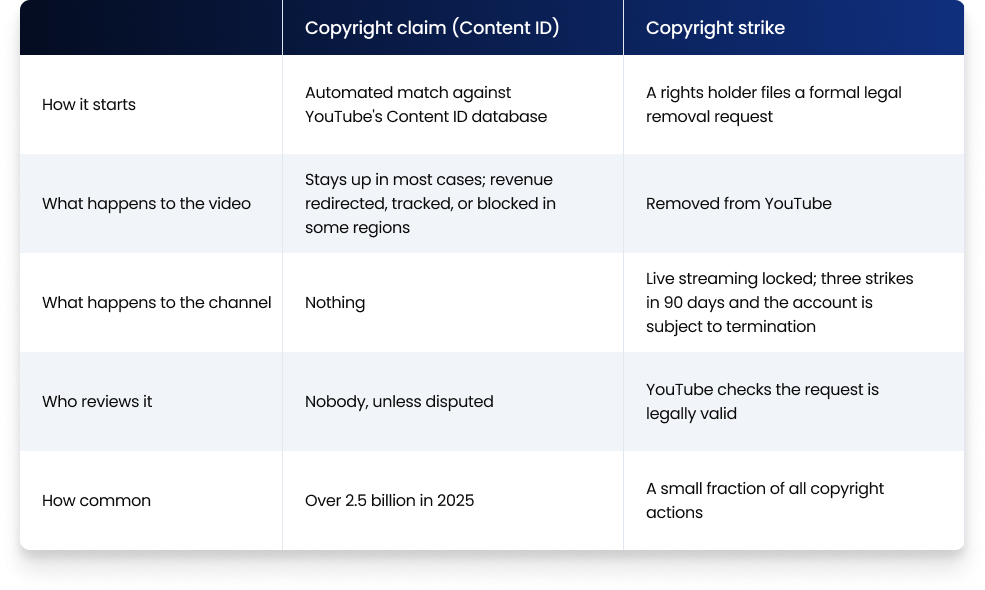
YouTube's own wording, from its Content ID claim documentation, is blunt: Content ID claims are different from copyright removal requests and copyright strikes, and you will not receive a strike for a video that carries an active claim.
The two systems exist for different reasons. Claims are how rights holders make money from reuse of their content, and the numbers prove it: rights holders chose to monetise more than 90% of the claims placed in 2025, according to Google's Copyright Transparency Report. Strikes are how rights holders remove content they never want on the platform. Money versus removal. Automation versus legal process. Once you hold that frame, every decision in this area gets easier.
How a Copyright Claim Works (And Why It Rarely Hurts)
When one of your videos gets claimed, it means YouTube's Content ID system matched part of it, the audio, the visuals, or both, against a reference file a rights holder registered. The claim lands in YouTube Studio with the details: which asset matched, which segment of your video, and what the claimant's policy does to it.
Three outcomes are possible. The claimant monetises your video, meaning ads run and the revenue goes to them rather than you. They track it, meaning nothing visible changes and they just collect viewing data. Or they block it, in some countries or everywhere. Monetise is by far the most common outcome, which is why most claims on brand channels cost a slice of revenue on one video and nothing more.
What a claim never does is punish your channel. It does not affect your standing in the YouTube Partner Program, your other videos, or your ability to upload. Fewer than 1% of claims get disputed at all, and of those disputes, around two thirds end in the uploader's favour, usually because the claimant releases the claim or lets the 30-day response window expire.
We explain the rights-holder side of this machinery, how the matching works and who gets access, in our full guide to YouTube Content ID.
How a Copyright Strike Works: The Three-Strike System
A strike is a different animal. It begins when a copyright owner files a formal removal request, a legal notice, not an automated match, and YouTube confirms the request is valid. The video comes down, the notification arrives from no-reply@youtube.com, and the strike attaches to your channel.
The first strike locks live streaming for seven days and sends you to Copyright School, a short mandatory course on YouTube's copyright rules. The strike expires after 90 days, provided Copyright School is completed. A second strike within that window extends the restrictions to 14 days. A third active strike within 90 days is the one that matters: per YouTube's strike documentation, your account, along with any associated channels, becomes subject to termination.
Read that phrase again if you run a multi-channel operation: any associated channels. Brand channels are usually structured under shared Google accounts or Brand Accounts, which means three strikes on one small regional channel can put your flagship channel at risk. Deleting the offending video does not remove the strike. The only ways out are waiting out the 90 days, persuading the claimant to retract, or filing a counter-notification and winning.
There are three legitimate escape routes. A retraction, where the claimant withdraws the request. A counter-notification, a legal response asserting the removal was a mistake or the content was misidentified, which reinstates the video if the claimant does not begin court action within the statutory window. And expiry, the 90-day clock. For a brand, the right route depends entirely on how strong your rights position actually is, which is a question for whoever manages your licences, not for whoever manages your uploads.
Why Brand Channels Get Claimed in the First Place
Brands tend to assume copyright problems only happen to creators who use other people's content carelessly. Then the claims arrive anyway. The usual suspects are mundane.
Music beds are the biggest one. A production partner scores a video with a track they licensed from a library, but the licence covers their use, not your channel, or the library's own Content ID registration is broader than the licence it sold. Stock footage behaves the same way. Archive content is worse: a broadcaster's back catalogue often contains third-party clips, sports footage, or music that was cleared for the original broadcast decades ago and never cleared for YouTube.
The pattern underneath all of these is the same. Somewhere between the edit suite and the upload, the paperwork and the platform disagree about who owns what. That is why claims on "fully cleared" videos are normal, and why the fix is procedural rather than technical: keep a licence register, know what every reference in your videos is, and record who cleared it. Channels working with a YouTube channel management partner should expect claim handling to be part of the service, not an emergency each time.
Dispute or Edit It Out? The Decision Brands Get Wrong
When a claim lands, YouTube Studio offers you a dispute button, and the 30-day process behind it is straightforward: you dispute, the claimant has 30 days to release the claim, reinstate it, or escalate. If they do nothing, the claim releases automatically.
The decision is not whether you can dispute. It is whether you should. Dispute when your position is clean: you hold a written licence that covers this use on this channel, the content is public domain, or the match is simply wrong. In those cases, dispute with the evidence attached and expect to win.
Edit instead when the claimed segment is not worth the fight. Studio's editing tools let you trim the claimed section, replace the audio, or mute the segment without re-uploading, and the claim lifts once the claimed content is gone. For a music bed under a corporate video, that is a 20-minute fix versus a 30-day process.
And here is the risk that makes this decision serious rather than administrative. YouTube's dispute guidance warns that a claimant faced with a dispute they believe is invalid can respond by filing a formal removal request instead. In other words, a badly judged dispute can convert a harmless claim into a strike. That is the escalation path brands need their teams to understand before anyone presses the button. If the licence position is murky, edit, do not dispute.
The Other Side: Issuing Takedowns as a Rights Holder
Now flip the table. Someone is uploading your content, and you want it gone or you want it paying you. You have three tools, and they scale very differently.
The public webform is available to everyone and handles one video at a time. It files a formal removal request, the same instrument that creates strikes, and it offers a useful courtesy option: a 7-day delayed takedown, which gives the uploader a week to remove the video themselves and avoid the strike. More than 60% of claimants used the webform in 2025. It is also where the abuse lives: over 6% of webform removal requests in 2025 were assessed as likely false ownership assertions, roughly ten times the abuse rate of YouTube's restricted tools.
The Copyright Match Tool, available to over 4 million channels, automatically finds full re-uploads of your own videos and queues them for your review. You choose whether to request removal. No monetisation options, no segment matching, but free and effective against straight piracy of your uploads.
Content ID is the industrial option, restricted to around 7,600 approved rights holders, and it generates over 99% of all copyright actions on YouTube. It monetises rather than removes, which for most catalogues is the better trade.
Two legal cautions before your team starts filing. First, a takedown notice is a legal statement, and under the US DMCA's section 512(f), knowingly misrepresenting ownership in one can make you liable for damages and legal fees. Brands filing at volume need an audit trail proving ownership before each request goes out. Second, uploaders can counter-notify, and if you do not begin court action within the statutory window, the video goes back up and the strike clears. Do not file takedowns you are not prepared to stand behind.
What the Numbers Say About How This Actually Plays Out
The 2025 Transparency Report data is worth internalising, because it tells you where the real risk sits.
Content ID claims ran to more than 2.5 billion, and over 90% were monetised rather than blocked. Strikes and removal requests are a rounding error by comparison. Disputes touched fewer than 1% of claims. The system, at scale, is not a battlefield. It is a payments network with a legal enforcement lane bolted to the side.
The failure cases cluster in that legal lane. The webform's 6%+ abuse rate includes false claimants asserting ownership of content they do not own, and extortion patterns where bad actors strike a channel and demand payment to retract. Public disputes, like the wave of complaints in 2024 around invalid strikes on public-domain Shakespeare material, and creator backlash against aggressive news-agency enforcement in 2025, show the reputational cost of getting enforcement wrong. For a brand, the lesson runs both ways: guard against abusive claims on your channels, and never let your own enforcement become the case study. Blanket-striking fan content that was extending your reach is how broadcasters end up trending for the wrong reasons.
Managing Copyright Risk Across a Channel Portfolio
At one channel, copyright is an occasional annoyance. At 10 to 50 channels, it needs to be run like a function, because the account structure multiplies the stakes: strikes aggregate across associated channels, so the worst-case scenario is portfolio-wide.
Four disciplines cover most of the risk. Keep a central licence register recording every piece of third-party material in your content, what the licence covers, and when it expires, so every dispute decision starts from evidence. Give claim response a single owner with Studio access across all channels and a logged workflow, because the 30-day dispute window and 7-day scheduled-takedown window do not wait for whoever is on holiday. Separate high-risk archive or clips channels from flagship channels at the account level where the structure allows it. And track claims as a revenue and risk line, not a support ticket queue.
At The Polar Bears, the monitoring side of this sits in Powered by Vixxi, the platform we license to consolidate YouTube, Google Ads, and Google Ad Manager into one workflow. Claim activity and revenue impact show up alongside normal channel performance, so a spike in claims on one channel gets noticed in days rather than at quarter end. The tooling matters less than the habit: if nobody reviews copyright activity across the portfolio weekly, the first time you hear about a strike problem will be strike number two.
FAQ
What is the difference between a copyright claim and a copyright strike on YouTube?
A copyright claim is an automated Content ID match that affects only the claimed video, usually by redirecting its ad revenue to the rights holder. A copyright strike results from a formal legal removal request: the video is taken down and the strike counts against the channel. Three strikes in 90 days can terminate the account.
Can a copyright claim turn into a copyright strike?
Yes, though it is rare. If you dispute a claim and the rights holder responds by filing a valid removal request instead, the video is removed and a strike is applied. This is why disputes should only be filed when you are confident you hold the necessary rights.
What happens if you get three copyright strikes on YouTube?
The account, along with any associated channels, becomes subject to termination. Uploaded content becomes inaccessible and the owner is barred from creating or running other YouTube channels. For brands, linked channel structures mean strikes on one channel can endanger the whole portfolio.
How long does a YouTube copyright strike last?
A strike expires after 90 days, provided the channel completes Copyright School and holds fewer than three active strikes. It can also be resolved earlier by a retraction from the claimant or a successful counter-notification.
Is it worth disputing a copyright claim on YouTube?
Only when you clearly hold the rights: a written licence covering the use, public-domain content, or a mismatch. YouTube warns that repeated or baseless disputes can lead to penalties, and a claimant can escalate a dispute into a removal request that carries a strike. When the position is unclear, editing out the claimed content is usually the safer fix.
Do copyright strikes happen automatically?
No. Claims are automated through Content ID, but strikes only happen when a rights holder manually files a legal removal request and YouTube validates it. That human step is exactly why strikes are rarer and more serious than claims.
Want copyright risk handled properly across your channels
If you liked that why not take a look
YouTube Content ID Explained: How Rights Holders Protect and Monetise Their IP
What YouTube Content ID is, who gets access, and how rights holders use it to protect and monetise content. Payouts, policies and pitfalls explained.
What Security and Compliance Should a YouTube Agency Have?
Your agency holds your accounts and data. What SOC 2, ISO 27001, GDPR and Cyber Essentials actually mean, and what to ask before you sign.
Should Your YouTube Agency Work With Your Competitors?
Your agency might run your rival's channel too. Why agency conflict of interest matters, how good agencies keep competing clients apart, and what to ask.
What Should a YouTube Agency Put in Writing?
Most YouTube agencies dodge written commitments. What a good agency should promise: response times, reporting cadence, and fixing underperforming videos.
What Data Can You Take When You Leave a YouTube Agency?
Can you take your analytics, dashboards and custom reports when you leave a YouTube agency? What data is yours, what is not, and how to avoid lock-in.
Who Owns Your YouTube Channel When You Use an Agency?
You should own your YouTube channel, not your agency. How channel ownership works, owner vs manager access, and how to keep control on exit.

Ready to maximise your YouTube revenue?
Get in touch and let’s begin exploring your channel’s hidden potential.