How to Audit Your YouTube Channel: A DIY Framework

How to Audit Your YouTube Channel
A proper YouTube channel audit answers one question: where is the biggest gap between what your channel is doing and what it could be doing? Most channels never run one. They tweak thumbnails, change posting schedules, redesign the banner, and call it a refresh. A real audit is structured, data-led, and produces a prioritised list of fixes rather than a feeling.
The DIY framework below covers eight areas: channel-level metrics, video-level performance, content strategy, packaging, branding and design, optimisation hygiene, audience signals, and monetisation. Run through it once with YouTube Studio open and a spreadsheet ready, and you'll have a clear ranked list of what to fix first.
What a Full YouTube Channel Audit Covers
A complete audit looks at these categories:
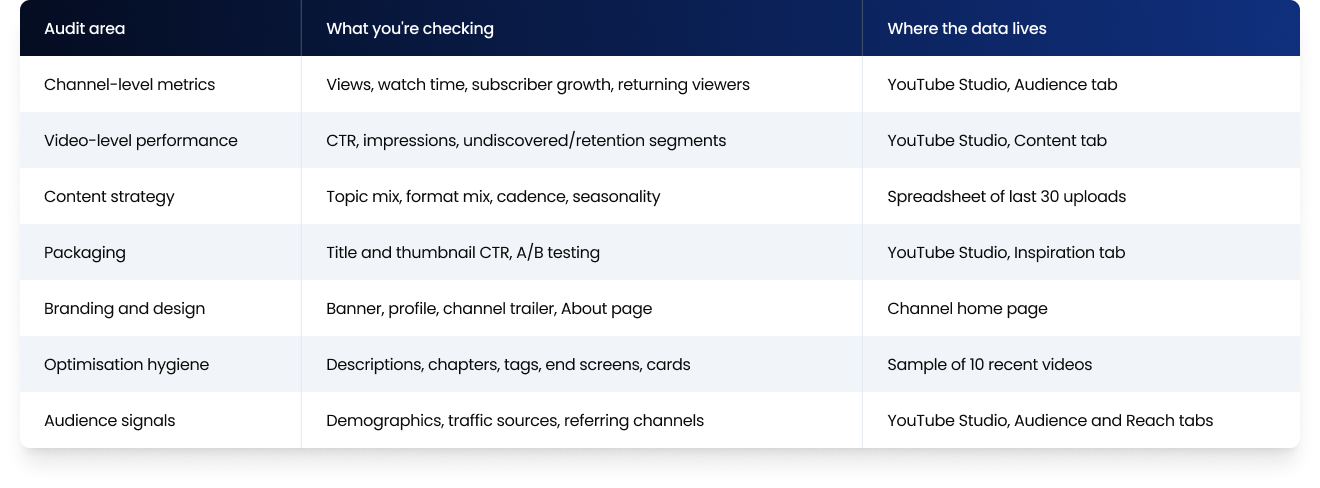
Most DIY audits skip half of this. The skipped half is usually where the biggest gains sit.
The Metrics That Actually Matter in 2026
YouTube Studio shows you dozens of metrics. Seven of them carry most of the weight when assessing channel health. We covered the same set in detail in our breakdown of the metrics that actually matter in 2026.
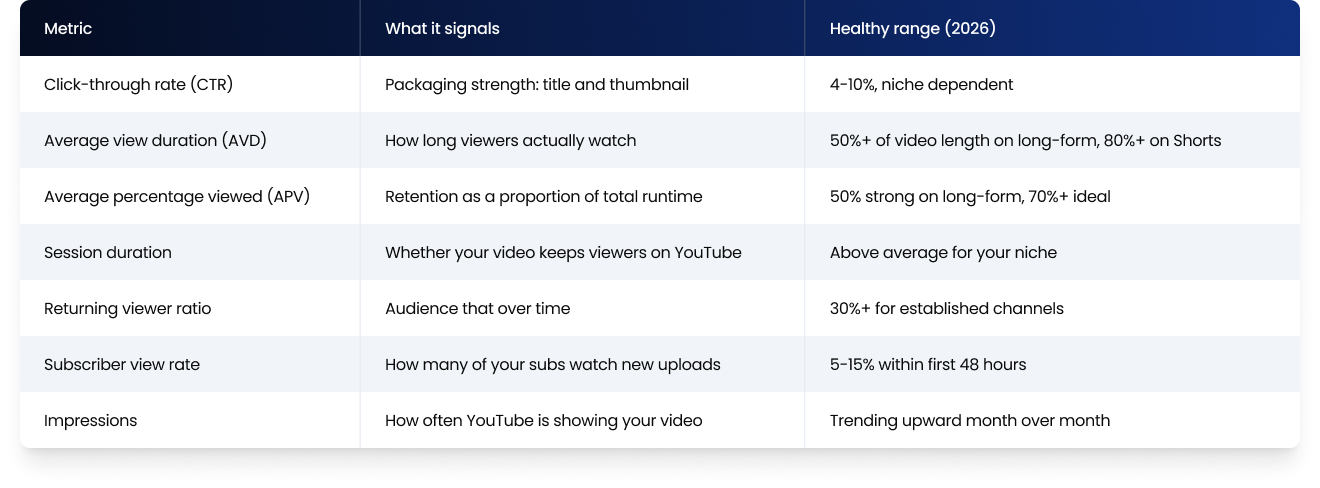
Vanity metrics (total subscriber count, total views, gross uploads) tell you about the past. The metrics above tell you about the future.
CTR Benchmarks by Niche
A "good" CTR depends entirely on what your channel covers. The realistic 2026 ranges, drawn from vidIQ's published benchmark data and TubeBuddy's channel data:
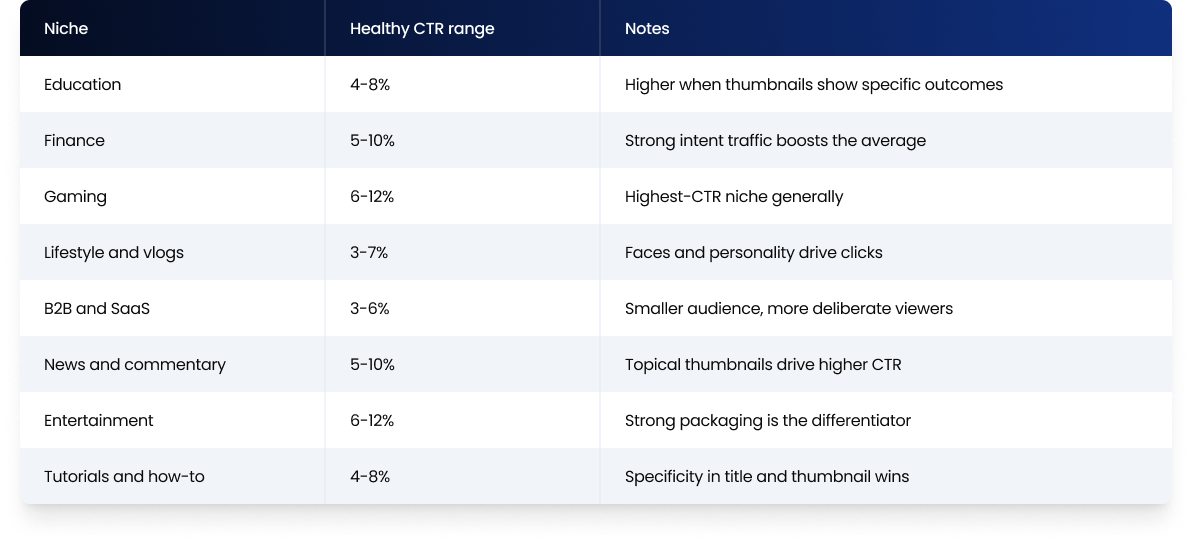
A CTR consistently below 2% across a channel almost always points to packaging, not content. The video might be excellent. If the title and thumbnail aren't selling the click, the algorithm never finds out. Our deep-dive on why thumbnails matter more than most channels realise breaks down the patterns that lift CTR.
Retention Benchmarks That Matter
Average percentage viewed (AVP) varies by video length:
For long-form videos (8+ minutes): 50%+ AVP is healthy. 60%+ is strong. Below 40% suggests structural problems with the video, often in the first 30 seconds.
For mid-form videos (3-7 minutes): 55-65% AVP is the realistic target. Mid-form is the toughest length to retain on, because viewers expect either short payoff or long depth.
For Shorts: 70%+ AVP is the floor. The platform expects Shorts to be watched almost in full. Anything below 60% throttles distribution fast.
The retention curve matters more than the headline number. A flat curve from start to finish is healthier than a high AVP that comes from a small group of viewers watching the whole video while everyone else bails in the first 15 seconds.
The Audit Workflow
A repeatable workflow takes around two hours per channel:
1. Open YouTube Studio. Set the date range to the last 90 days.
2. Go to the Audience tab. Note returning vs new viewers, demographics, watch time from subscribers.
3. Go to Content. Sort by views in the period. Identify the top 5 performers and the bottom 5.
4. Open each top performer. Look at the retention curve, traffic sources, and CTR. Write down the pattern (the title style, thumbnail style, topic, hook type).
5. Open each bottom performer and run the same checks, then write down what they have in common.
6. Compare. The differences between top and bottom are your strategy lessons.
7. Open the channel home page. Check banner, profile, channel trailer, About text, playlist organisation.
8. Open ten recent video pages. Check description first 150 characters, chapter markers, end screens, links, hashtags.
9. Open the Inspiration tab. Note any A/B test results and abandoned tests.
10. Build a prioritised fix list. Three categories: quick wins (less than an hour each), medium fixes (a week), strategic changes (a month or more).
A spreadsheet is enough. The point is producing a ranked list of fixes, not making a beautiful document.
Packaging Audit: Where Most Channels Leak
Packaging is the highest-use audit area. A channel with strong content and weak packaging always underperforms. The reverse is rarely true.
The packaging audit covers four things:
Title CTR by video. Sort the last 30 videos by CTR and look for patterns. The top performers usually share a structural shape (specific number, clear payoff, named entity, contrast). The bottom performers usually share a structural shape too (vague phrasing, too clever, no payoff stated).
Thumbnail CTR by video. Same exercise. Strong thumbnails almost always isolate one element clearly. Weak thumbnails are busy or unreadable on mobile.
Title-thumbnail alignment. The title and thumbnail should reinforce each other, not repeat each other. A title that asks a question paired with a thumbnail that answers it works. A thumbnail with the title written across it usually doesn't.
A/B test history. Channels using YouTube's native A/B testing tool should have a record of which thumbnail variants won. Channels that never test are leaking compounding gains.
Content Gap Audit
The content gap audit answers a simple question: what should this channel be making that it isn't? Three sources reveal the answer:
Comments. Pinned and top-voted comments on videos often contain direct content requests. "Can you do a video on X?" is the most undervalued source of validated topic ideas.
YouTube Studio's Inspiration tab. The "Search insights" feature shows what your audience and similar audiences are searching for that you haven't covered.
Top videos in your niche. The simple exercise of typing your three core keywords into YouTube and noting the top-performing recent videos reveals what's working in your space right now.
Branding Audit
The branding audit is short but important:
The banner is the first thing to check: does it tell a viewer in three seconds who the channel is for and what kind of content it makes?
The profile picture needs to be recognisable at thumbnail size and on-brand with everything else on the channel.
Channel trailers fail when they're old, aimed at the wrong audience, or run too long. A good one is recent, targeted at non-subscribers, and stays under two minutes.
The About section is doing more work than most channels realise — the first three sentences should sell the subscribe.
Playlists need to be organised by topic rather than upload date, with the strongest ones pinned to the channel home and each one given a custom thumbnail and description.
Finally, the channel sections viewers see when they land on the home page are converting visits into subscribes (or not). Order them with that job in mind, not by what feels neat.
Red Flags to Watch For
Five patterns signal a channel in trouble:
CTR declining for 60+ days. Either the algorithm is showing your videos to weaker audiences, or your packaging is no longer pulling clicks.
AVP dropping across recent uploads. Retention is the strongest health metric. Sustained drops mean the content has drifted from what your audience actually wants.
Returning viewer ratio falling. Existing subscribers are losing interest. This usually precedes a wider drop in distribution.
Session duration falling. Your videos are no longer keeping viewers on the platform afterwards. The algorithm responds to this directly by suppressing your reach.
Comments slowing or going negative. Audience signal often shifts in comments before it shows up in retention data.
When DIY Hits Its Limit
DIY auditing handles 80% of what most channels need. The point at which it hits a ceiling is usually one of three:
The audit reveals problems but the channel doesn't have time to fix them at the pace required.
The audit reveals patterns the channel can't diagnose without external benchmark data.
The audit reveals strategic gaps that need a different content direction, which is hard to set internally without distance.
At The Polar Bears, our Channel Strategy service handles the audit and the execution as a single workstream. The pattern we see across the brands and creators we work with is consistent: the audit is the easy part. The follow-through over 90 days is where the wins compound.
FAQ
How often should I audit my YouTube channel?
A full YouTube channel audit should run quarterly. Lighter monthly checks on the seven core metrics (CTR, AVD, AVP, session duration, returning viewers, subs view rate, impressions) catch problems early. Annual deep audits set strategic direction. Channels publishing weekly benefit from the monthly cadence; lower-frequency channels can run quarterly only.
What is a good CTR for YouTube in 2026?
A healthy YouTube CTR in 2026 is between 4% and 10%, depending on niche. Education and B2B channels tend to land at the lower end. Gaming and entertainment channels run higher. CTR consistently below 2% almost always signals packaging weakness, not content weakness.
How do I check audience retention on YouTube?
Open YouTube Studio, click Content, then click any video. The Analytics tab on each video page shows the audience retention curve, average view duration, and average percentage viewed. The Audience tab on the channel level shows aggregated retention patterns across the channel.
What metrics should I look at first when auditing my channel?
Start with three metrics: average percentage viewed, click-through rate, and returning viewer ratio. AVP tells you whether viewers care about the content. CTR tells you whether your packaging works. Returning viewers tells you whether the audience is sticking around. Most channel problems show up in one of those three before showing up in subscriber count.
How long does a YouTube channel audit take?
A full DIY YouTube channel audit takes 2-4 hours for a channel with 50-200 videos. Smaller channels finish faster. Larger channels with hundreds of videos usually focus the audit on the last 90 days of uploads and the top 20 lifetime performers, which keeps the time investment manageable.
What is a good audience retention rate on YouTube?
A good audience retention rate on YouTube depends on video length. For long-form videos (8+ minutes), 50%+ average percentage viewed is healthy and 60%+ is strong. For Shorts, 70%+ is the floor. Below 40% on long-form usually signals a structural problem with the video, often in the first 30 seconds.
Can I audit my YouTube channel myself or do I need an agency?
You can audit your own YouTube channel using YouTube Studio and a structured framework. DIY auditing handles around 80% of what most channels need. An agency adds value when the audit reveals patterns that need external benchmark data, or when the volume of fixes is too high to execute internally at the pace required.
Want a channel audit without lifting a finger?
If you liked that why not take a look

Copyright Claims vs Strikes: What Brands and Broadcasters Need to Know
Copyright claims and strikes are not the same thing. What each does to your channel, when to dispute, and how brands manage copyright risk at scale.
YouTube Content ID Explained: How Rights Holders Protect and Monetise Their IP
What YouTube Content ID is, who gets access, and how rights holders use it to protect and monetise content. Payouts, policies and pitfalls explained.
What Security and Compliance Should a YouTube Agency Have?
Your agency holds your accounts and data. What SOC 2, ISO 27001, GDPR and Cyber Essentials actually mean, and what to ask before you sign.
Should Your YouTube Agency Work With Your Competitors?
Your agency might run your rival's channel too. Why agency conflict of interest matters, how good agencies keep competing clients apart, and what to ask.
What Should a YouTube Agency Put in Writing?
Most YouTube agencies dodge written commitments. What a good agency should promise: response times, reporting cadence, and fixing underperforming videos.
What Data Can You Take When You Leave a YouTube Agency?
Can you take your analytics, dashboards and custom reports when you leave a YouTube agency? What data is yours, what is not, and how to avoid lock-in.

Ready to maximise your YouTube revenue?
Get in touch and let’s begin exploring your channel’s hidden potential.