How to Research YouTube Keywords Like a Pro (2026)

How to Research YouTube Keywords Like a Pro
YouTube keyword research in 2026 is less about exact-match phrases and more about reading viewer intent. The platform's ranking systems read transcripts and chapters semantically. AI engines pull citations from videos that answer specific questions clearly. Both reward content that targets a real query rather than one stuffed with optimised phrasing.
The workflow that actually works in 2026 has four steps: pick a seed keyword from genuine viewer demand, validate volume and competition with one paid tool, expand into question-format and conversational variants for AEO and GEO, and map the result to a video angle that matches search intent. Get those right and the rest of YouTube optimisation gets dramatically easier.
Does YouTube Keyword Research Still Matter in 2026?
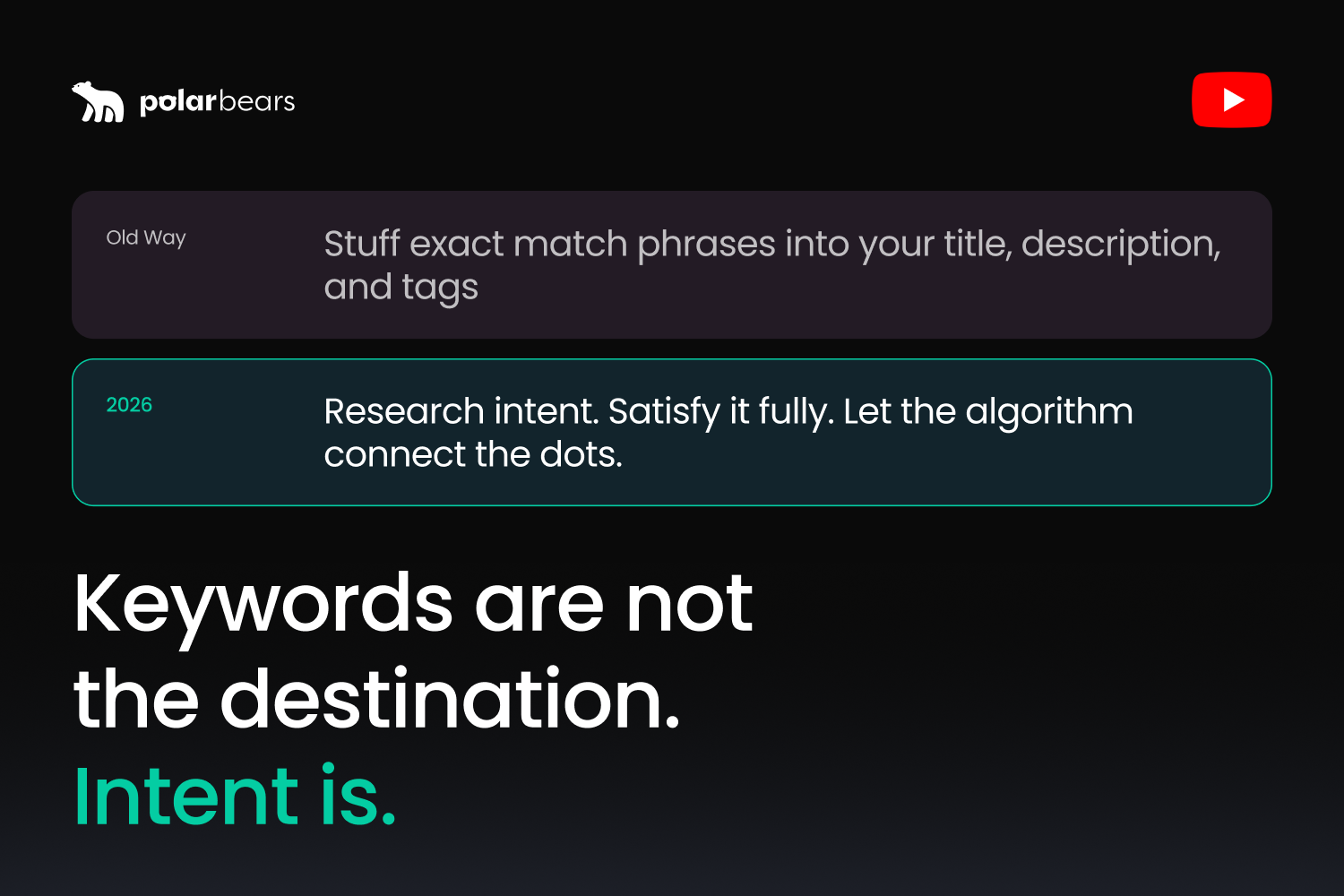
Yes, but the unit of work has changed. Keywords aren't the destination any more — intent is.
The shift is straightforward. Two years ago, ranking on YouTube meant placing an exact-match phrase in the title, description, and tags. Today, the platform reads natural language across the title, transcript, chapters, and description, then matches that combined signal against the intent of the searcher. A video titled "How to Lower Your YouTube CPV" can rank for "reduce YouTube ad costs," "cheaper YouTube ads," and "make YouTube ads more efficient" without any of those phrases appearing verbatim.
What this means in practice: research keywords to understand what viewers want, not to inject specific strings into your metadata. The keyword tells you the intent. The video then has to genuinely satisfy it.
Search Intent for YouTube: The Four Types
Every YouTube keyword maps to one of four intent types. Knowing which one you're targeting changes the format of the video.
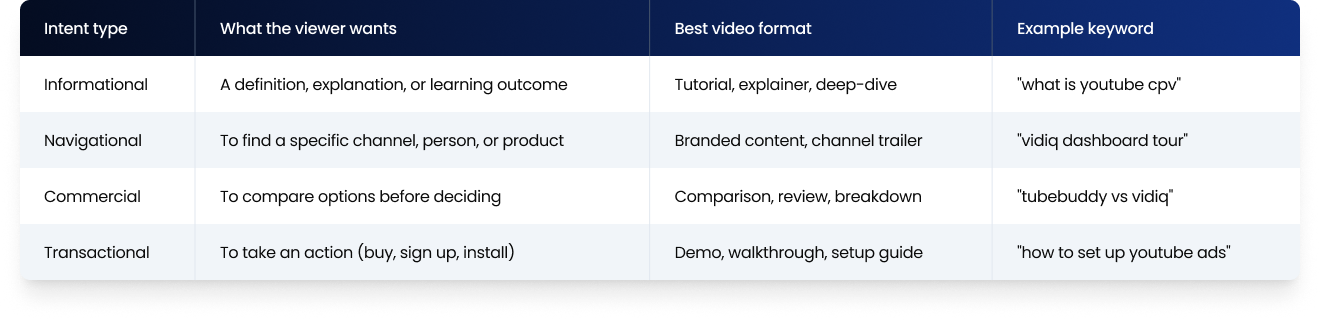
Targeting the wrong intent kills retention even when the keyword research is technically correct. A "how much does X cost" keyword has commercial intent. The viewer wants a number. A 12-minute video that takes nine minutes to give them the number gets closed at minute three.
Tool Comparison for YouTube Keyword Research in 2026
The honest version of the tool landscape:
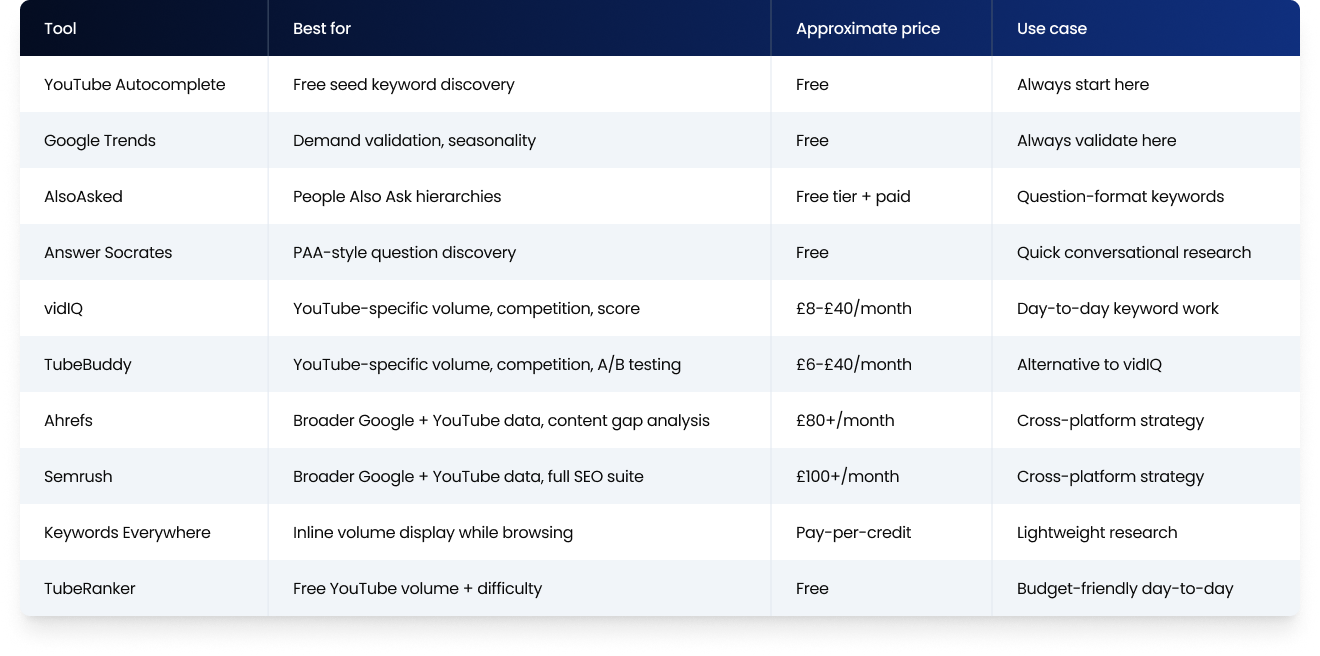
You don't need all of these. A workable stack for most channels is YouTube Autocomplete, Google Trends, AlsoAsked, and one paid YouTube-specific tool. Channels that are also doing wider content marketing add Ahrefs or Semrush on top.
The Research Workflow That Works
A repeatable workflow looks like this:
1. Start with YouTube Autocomplete. Type a seed term and let YouTube suggest the actual phrases people search for. These are real queries with real volume, even if you can't see the numbers yet.
2. Pull related searches. Scroll to the bottom of YouTube search results for "Related searches." This is one of the most underused free signals on the platform.
3. Validate with vidIQ or TubeBuddy. Plug the candidate keyword into your paid tool of choice. You're looking for moderate volume with manageable competition. Hyper-competitive keywords are usually a worse bet than long-tail variants of the same intent.
4. Validate with Google Trends. Confirm the keyword has stable or rising demand. Falling-demand keywords are a trap: even a perfect video for one will plateau.
5. Pull PAA questions with AlsoAsked or Answer Socrates. These become FAQ-section content for the video description, blog post, or video itself. They also tell you what AI engines are likely to be asked.
6. Cluster around intent. Group keywords by what the viewer wants, not by surface-level word similarity. "How much do YouTube ads cost" and "are YouTube ads expensive" are the same query.
7. Map to a video angle. One keyword cluster equals one video. Don't try to target three intent types in one piece of content; that's how watch time collapses.
Long-Tail vs Head Keywords: How to Weigh the Trade-Off
The pattern that holds across most niches in 2026:
Long-tail keywords (4+ words, more specific) are generally where small and mid-sized channels should focus first. Lower competition, higher intent, easier to satisfy fully in a single video. According to Backlinko's keyword research data, roughly 70% of all searches across Google are long-tail, and the same pattern broadly holds on YouTube.
Head keywords (1-2 words, broad) belong to channels that already have authority and back catalogue depth. Going for "youtube seo" as a small channel is a slow loss. Going for "youtube seo for b2b saas in 2026" is a fast win.
The strongest channel keyword strategies stack long-tail wins until they earn the right to rank for the head term. By the time you've published 30 videos targeting specific long-tail variants of "youtube ads," ranking for "youtube ads" itself is suddenly possible because the channel has accumulated semantic authority on the topic.
Evergreen vs Trending: The Right Mix
A healthy keyword strategy combines both:
Evergreen keywords have stable demand and pay back over years. "How to write YouTube titles" gets the same searches in March as it does in October. These build the spine of a content calendar.
Trending keywords have a sharp spike of demand around an event, platform update, or news moment. "YouTube algorithm change September 2026" might do 10x normal volume for two weeks, then collapse.
The mix that works for most brand and creator channels is roughly 70% evergreen, 30% trending. Evergreen content compounds. Trending content gets fast wins and signals freshness to the algorithm. Going 100% on either is a slower path than the mix.
Where Tags Sit in 2026
Tags are mostly a checkbox in 2026. YouTube's official tag guidance is that tags help disambiguate misspelt or ambiguous niche terms, and not much else. Most ranking signal comes from titles, descriptions, transcripts, and chapter markers.
A reasonable approach: spend 30 seconds adding 5-8 tags that include your primary keyword and obvious variations. Move on. Time spent obsessing over tag order or count is time better spent on a chapter restructure.
Deploying Keywords Across Title, Description, Transcript, and Chapters
Once you have a validated keyword cluster, here's where the keywords actually go:
Title. Primary keyword in the first half, written as a phrase a human would type. Secondary keyword folded in if it can be done without making the title clunky. Our guide to writing YouTube titles that rank breaks the patterns down.
Description first 150 characters. Primary keyword present, but the priority is a clean hook that doubles as an AI-citation summary.
Description full body. Supporting keywords from the cluster, woven in naturally across the 300-500 word summary section.
Chapter titles. Question-format chapters using the PAA variants from your research. These are the unsung hero of AEO and GEO.
Transcript. Speak naturally, but if the keyword and its variants don't come up in the script, it's worth tweaking. The transcript is read semantically; you don't need exact match, but you do need topical density.
At The Polar Bears, our Video Optimisation service runs this exact workflow at scale across every video a client uploads. The pattern we see across channels is consistent: keyword research isn't a one-off project that lives in a spreadsheet. It's a recurring discipline that compounds when applied to every video, not just the obvious ones.
Mistakes to Avoid
The traps that show up most often:
Targeting head keywords too early. You can't outrank an established channel on volume alone. Win the long-tail first.
Optimising for keywords with no real intent. "Youtube tips for life" sounds like a keyword. It's actually a vague phrase no one types with a clear goal.
Ignoring search intent. A how-to video for a comparison query loses every time, regardless of how strong the keyword research was.
Building a keyword list and never updating it. Search behaviour shifts. A keyword that was a goldmine in 2024 may be saturated by 2026.
Skipping AlsoAsked or PAA research. The questions are where AEO and GEO citations are won or lost.
FAQ
What are the best free YouTube keyword tools in 2026?
The strongest free YouTube keyword tools in 2026 are YouTube Autocomplete, Google Trends, AlsoAsked, and Answer Socrates. YouTube Autocomplete gives you real search phrases. Google Trends validates demand. AlsoAsked and Answer Socrates surface the People Also Ask questions that drive AEO and GEO citations.
Do YouTube tags still matter for SEO in 2026?
YouTube tags carry minimal ranking weight in 2026. YouTube's own guidance positions them as a tool for disambiguating misspelt or unusual niche terms. Most ranking signal comes from titles, descriptions, transcripts, and chapter markers. Spending more than a minute or two on tags per video is wasted effort.
How do I find low-competition YouTube keywords?
Low-competition YouTube keywords usually live in the long-tail. Use YouTube Autocomplete to find specific phrasings, then check vidIQ or TubeBuddy scores to confirm low difficulty. The pattern: 4+ word keywords, with clear intent, in niches where the top-ranking video has below 50,000 views.
What's the difference between YouTube SEO keywords and Google SEO keywords?
YouTube SEO keywords prioritise viewer intent on a video platform: how-to, tutorial, demo, comparison phrasing tends to outperform. Google SEO keywords cover the wider web and include text-first intents like definitions and lists. Many keywords overlap, but a strong YouTube keyword usually maps to a clear video format, while a strong Google keyword may not need video at all.
How long should a YouTube keyword be for the best rankings?
Long-tail keywords of 4 or more words usually deliver the best ranking outcomes for small and mid-sized channels in 2026. They have lower competition and clearer intent. Shorter, broader keywords are reachable only after a channel has built semantic authority on the topic over many videos.
How often should I refresh my YouTube keyword research?
Refresh YouTube keyword research at least quarterly. Search behaviour shifts, platform updates change which queries surface, and new competitor channels can saturate keywords that were open a year ago. Channels publishing weekly should review keyword performance monthly to catch underperformers early.
Are AI tools useful for YouTube keyword research?
AI tools are useful for expanding a seed keyword into conversational and question-format variants, which directly feed AEO and GEO. They are less reliable for volume and competition data, where dedicated tools like vidIQ and Ahrefs still outperform. The strongest 2026 stack uses AI for ideation and expansion, paired with traditional tools for validation.
Want a keyword research and optimisation system running across every video you upload?
If you liked that why not take a look

Copyright Claims vs Strikes: What Brands and Broadcasters Need to Know
Copyright claims and strikes are not the same thing. What each does to your channel, when to dispute, and how brands manage copyright risk at scale.
YouTube Content ID Explained: How Rights Holders Protect and Monetise Their IP
What YouTube Content ID is, who gets access, and how rights holders use it to protect and monetise content. Payouts, policies and pitfalls explained.
What Security and Compliance Should a YouTube Agency Have?
Your agency holds your accounts and data. What SOC 2, ISO 27001, GDPR and Cyber Essentials actually mean, and what to ask before you sign.
Should Your YouTube Agency Work With Your Competitors?
Your agency might run your rival's channel too. Why agency conflict of interest matters, how good agencies keep competing clients apart, and what to ask.
What Should a YouTube Agency Put in Writing?
Most YouTube agencies dodge written commitments. What a good agency should promise: response times, reporting cadence, and fixing underperforming videos.
What Data Can You Take When You Leave a YouTube Agency?
Can you take your analytics, dashboards and custom reports when you leave a YouTube agency? What data is yours, what is not, and how to avoid lock-in.

Ready to maximise your YouTube revenue?
Get in touch and let’s begin exploring your channel’s hidden potential.