How to Vet a YouTube Agency: The 10 Questions That Actually Matter

How to Vet a YouTube Agency: The 10 Questions That Actually Matter
Every agency pitch looks great. The deck is slick, the case studies are enormous, the energy in the room is high. None of that tells you whether they will actually grow your channel.
The pitch is designed to impress you. The questions below are designed to find out the truth, and a good agency will welcome every one of them. Ten questions, grouped into the ones about results, the ones about the work, and the five most agencies quietly hope you never ask. Get straight answers to all ten and you will know exactly who you are dealing with before a contract goes anywhere near a desk.
A quick honest note before the list. Not every brand needs an agency, and we say so in our piece on doing YouTube SEO yourself versus hiring help. If you are posting twice a month and happy with your growth, save your money. These questions are for when you have decided you do need help and now have to pick the right people.
First, judge results, not the pitch
The case studies are where agencies look strongest and tell you least. Slick numbers hide more than they reveal, so push past them.
"Show me a channel like ours, with month-by-month numbers"
A huge subscriber count proves nothing on its own. Ask what the channel looked like the day they took it on, the growth rate month by month, how long before momentum kicked in, and which videos broke through. As the Humble&Brag guide to choosing a YouTube agency puts it, the recency and sustainability of growth matter far more than a peak number from two years ago.
"Are those channels still growing today?"
Ask for current monthly views, not all-time stats. A channel that spiked and has been flat ever since tells a very different story to one still compounding. If they only show you the spike, they are hoping you do not ask what happened next.
"Who will actually do our work?"
The people in the pitch are rarely the people on your account. Ask who runs the day-to-day, how many channels each manager handles, and whether anything is subcontracted. You are buying the team, not the founder's charm.
Then judge the work itself
How an agency decides what to make, and how it reports back, separates the strategists from the order-takers.
"How do you decide which videos to make?"
The answer should involve data. Competitor analysis, keyword research, audience signals, performance from existing content. "We'll brainstorm some ideas" is not a strategy. The way an agency picks topics is the way it will spend your budget, so make them show their working. Our breakdown of the metrics that actually matter is a good test of whether they talk in real signals or vanity numbers.
"What is your reporting cadence, and what do you commit to?"
A serious agency reports on a fixed rhythm and tells you what happens when a video underperforms. Vague reporting is where accountability goes to hide. You want documented response times, a set reporting schedule, and a clear answer on how they handle the videos that flop, because that reveals how they solve problems under pressure.
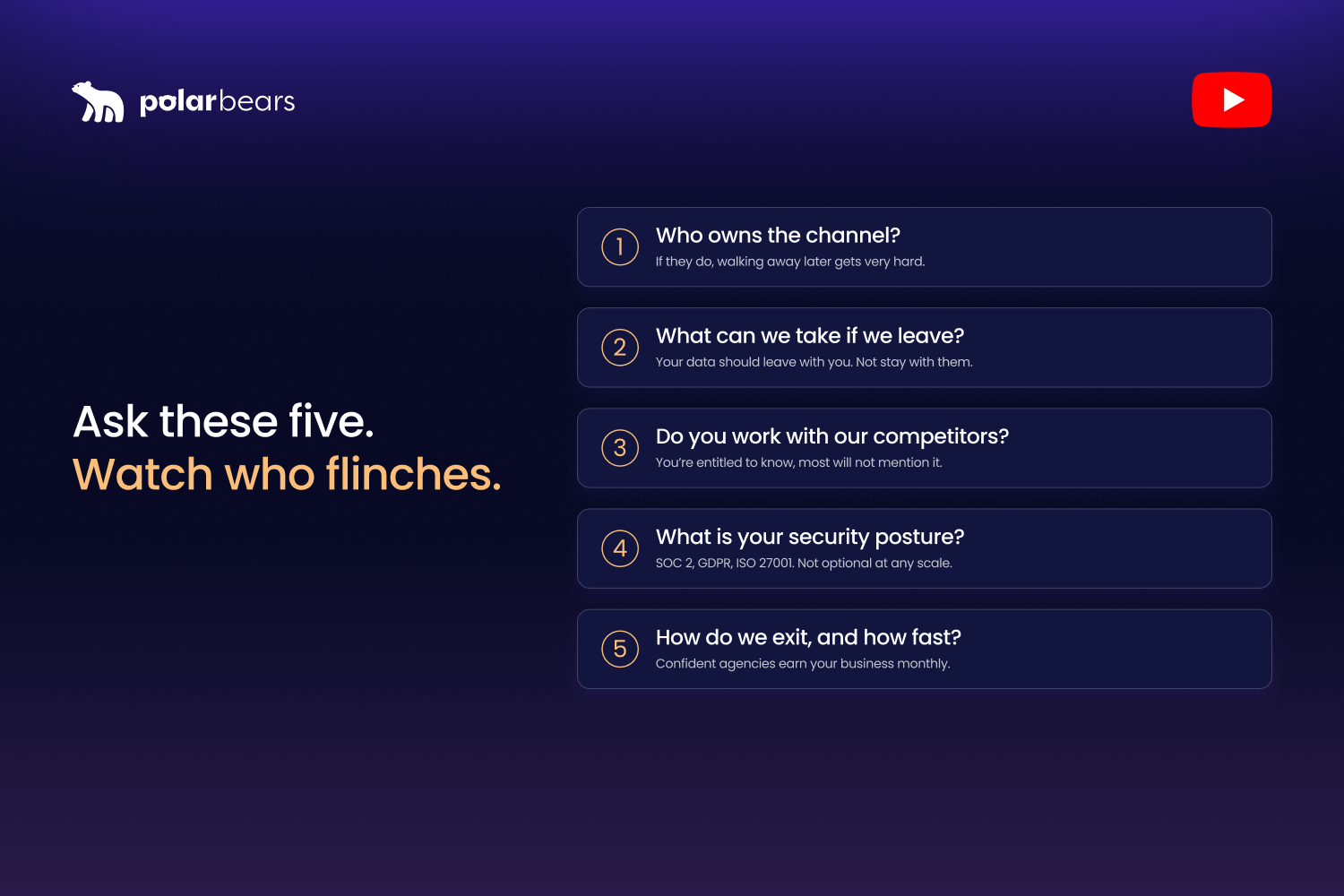
The five questions agencies hope you skip
These are the uncomfortable ones. They are also the ones that protect you when the relationship goes wrong, which is exactly why a weak agency will get squirmy. Ask all five.
"Who owns the channel, and what happens if we leave?"
You should own the channel and the Google account behind it, with the agency added as a manager. If an agency wants to register or hold the channel under its own account, walk away. The same rule applies across digital: if your provider controls the account, they control your business, and getting it back can be a fight.
"If we leave, what can we take with us?"
Ask what happens to your historical analytics, your dashboards, your custom reporting setup, and any data the agency holds on your performance. The right answer is that it is yours and it leaves with you. A good agency builds your reporting so it is portable, not so it traps you. At The Polar Bears the analytics layer is Powered by Vixxi, the platform we license to consolidate YouTube, Google Ads, and Google Ad Manager into one workflow, and a client's data is the client's data.
"Do you work with our direct competitors?"
A lot of agencies work with rival brands in the same vertical and never mention it. Ask directly. Two competing kids networks, two rival broadcasters, two labels chasing the same audience. You are entitled to know whether your strategy is being built by the same team building your competitor's, and to a straight answer on how they wall that off.
"What is your security and compliance posture?"
If you are a broadcaster, a rights holder, or any enterprise with a procurement team, this is not optional. Ask about SOC 2, GDPR, ISO 27001, and Cyber Essentials. These frameworks cover different things. ISO 27001 is about internal security processes, SOC 2 is about how they protect your data, and GDPR is the legal privacy floor. Cyber Essentials is a UK government-backed security baseline that procurement teams often ask for. An agency handling your accounts and your audience data should be able to answer on all of these without flinching.
"How long is the contract, and how do we exit?"
Ask the length, the notice period, and the exit terms before you fall in love with the pitch. An agency confident in its work earns your business month by month. One that needs a long lock-in before you have seen a single result is protecting itself, not you. More on why that matters in our look at what channel management actually costs.
How to read the answers
The questions are only half the job. The tells are in how they answer.
Watch for the dodge. A strong agency gives specifics, names the team, shows the numbers, and admits where things did not go to plan. A weak one talks in adjectives, redirects to the founder's track record, and gets vague exactly when you get specific. Honesty about a past failure is a better signal than a flawless story, because no real channel grows in a straight line and anyone claiming otherwise is editing.
When you do not need an agency
Worth saying plainly, because it builds the trust the rest of this is about. If your output is small, your growth is steady, and the operational load is manageable, you may be better off learning the basics and spending the budget elsewhere. The case for an agency gets strong when you are scaling, when the operations are eating your team alive, or when good content is not getting found. Our guide on what a YouTube agency actually does lays out where that line sits.
If you are past that line, run these ten questions on every agency on your shortlist. The right one will answer all of them without breaking stride. At The Polar Bears, we manage over two million videos for brands and broadcasters, and we would rather you asked all ten than signed without them. For the broadcasters and publishers we work with, the answers are the easy part.
FAQ
What questions should I ask a YouTube agency before hiring?
Ask for a comparable channel with month-by-month numbers, whether those channels are still growing, who actually does the work, how they decide what to make, and their reporting cadence. Then ask the five most skip: who owns the channel, what you can take on exit, whether they work with competitors, their security and compliance posture, and the contract length and exit terms.
How do I know if a YouTube agency is any good?
Look past the pitch and judge results: current monthly views on comparable channels, sustained rather than spiked growth, and honest answers about videos that underperformed. A good agency gives specifics and names the team on your account. A weak one talks in adjectives and gets vague when you get precise.
Do YouTube agencies own your channel?
They should not. You should own the channel and the Google account behind it, with the agency added as a manager. If an agency wants to hold the channel under its own account, treat it as a serious warning sign, because getting your channel back can become a legal fight.
How long does it take a YouTube agency to get results?
No agency delivers dramatic results in the first month. Paid campaigns can show early signals in four to six weeks, while organic growth and search typically take three to six months to move meaningfully. Any agency promising instant results is either guessing or misleading you.
Should a YouTube agency lock you into a long contract?
A confident agency earns your business month by month and offers clear exit terms. A long lock-in demanded before you have seen any results protects the agency, not you. Always ask the contract length, notice period, and any early-termination fees before signing.
What is the difference between a YouTube agency and a freelancer?
A freelancer can work for smaller channels with simple needs, but typically lacks the systems, data access, and cover that an agency has. An agency brings standardised workflows, a data platform, a dedicated team, and the ability to scale up or down. The risk with a freelancer is that when they get busy or go on holiday, your channel goes quiet.
Want an agency that answers all ten questions without flinching?
If you liked that why not take a look

Copyright Claims vs Strikes: What Brands and Broadcasters Need to Know
Copyright claims and strikes are not the same thing. What each does to your channel, when to dispute, and how brands manage copyright risk at scale.
YouTube Content ID Explained: How Rights Holders Protect and Monetise Their IP
What YouTube Content ID is, who gets access, and how rights holders use it to protect and monetise content. Payouts, policies and pitfalls explained.
What Security and Compliance Should a YouTube Agency Have?
Your agency holds your accounts and data. What SOC 2, ISO 27001, GDPR and Cyber Essentials actually mean, and what to ask before you sign.
Should Your YouTube Agency Work With Your Competitors?
Your agency might run your rival's channel too. Why agency conflict of interest matters, how good agencies keep competing clients apart, and what to ask.
What Should a YouTube Agency Put in Writing?
Most YouTube agencies dodge written commitments. What a good agency should promise: response times, reporting cadence, and fixing underperforming videos.
What Data Can You Take When You Leave a YouTube Agency?
Can you take your analytics, dashboards and custom reports when you leave a YouTube agency? What data is yours, what is not, and how to avoid lock-in.

Ready to maximise your YouTube revenue?
Get in touch and let’s begin exploring your channel’s hidden potential.