YouTube Agency Onboarding: What the First 90 Days Should Look Like

YouTube Agency Onboarding: What the First 90 Days Should Look Like
You have signed. The pitch is over, the money is committed, and now you wait. For a lot of brands, this is the scary bit, because the first month with a new agency can feel like silence, and silence makes you wonder if you just made an expensive mistake.
Here is the reassuring part. A good onboarding is busy, structured, and easy to recognise. There is a clear shape to the first 90 days, and once you know it, you can tell within weeks whether you hired well. This guide walks through that shape, what should be happening in each phase, what you should have in your hands by the end of each month, and the early signs of an agency that is drifting.
If you are still choosing and have not signed yet, our piece on vetting an agency is the place to start. This one is for after the ink is dry.
Why the first 90 days decide everything
The first three months set the tone for the whole relationship. This is when the agency learns your business, builds the strategy, and proves it can actually do the work. Get a strong start and the rest tends to follow. Get a vague, slow start and you are usually looking at a vague, slow year.
The thing to hold onto is that "no news" is not the same as "good work happening quietly." A serious agency communicates a plan, then shows you it moving. If you still cannot tell what your agency has done after three weeks, that itself is information.
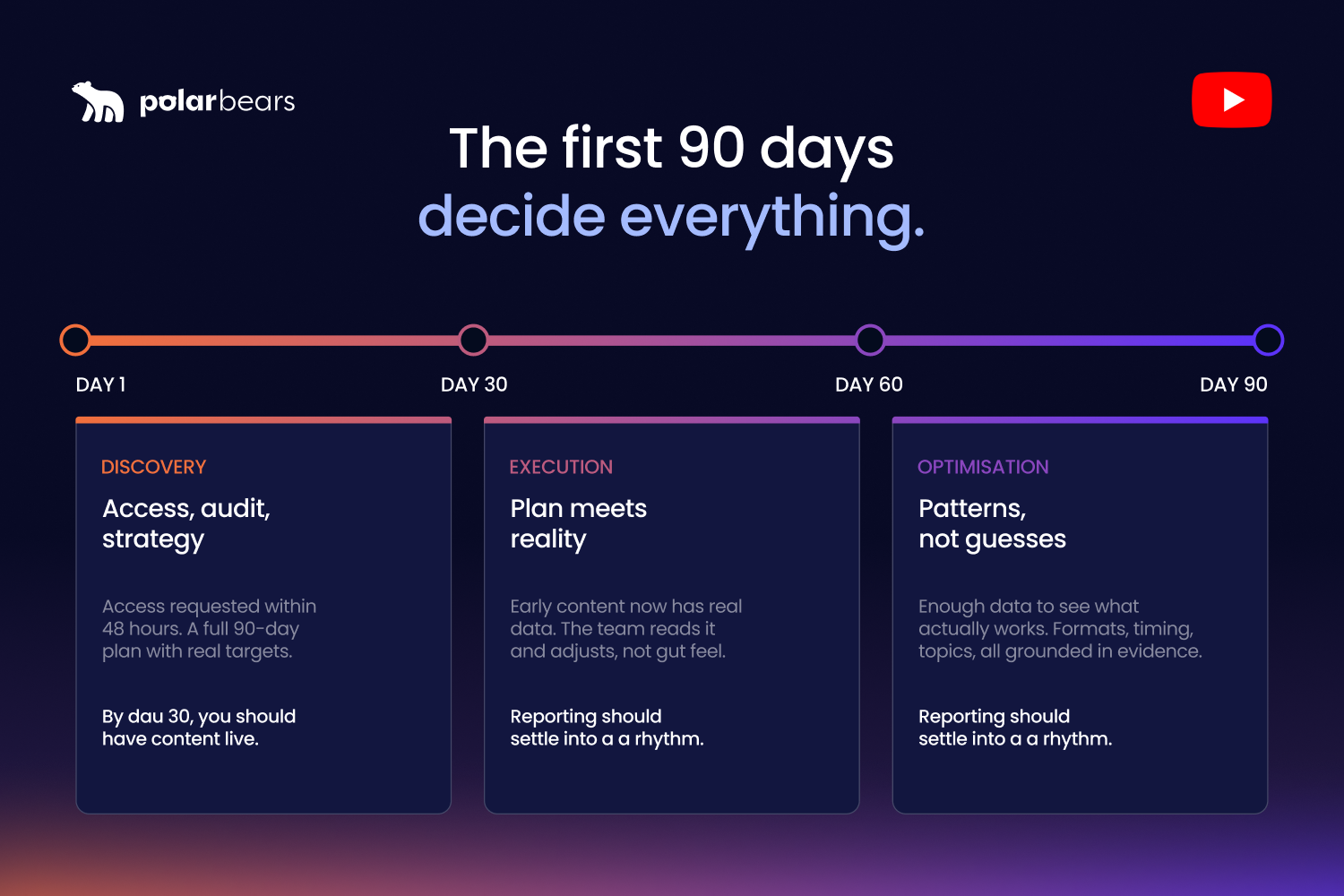
Days 1 to 30: discovery, access, and the audit
Month one is about the agency learning your channel inside out. It should move fast.
Getting access the right way
Within the first day or two, expect a clear request for access to everything they need to do the job. Your YouTube channel, YouTube Studio (the back end where a channel is managed), your analytics, your ad accounts, AdSense (the system that pays out your YouTube ad money), and your brand assets like logos and fonts. A well-run agency sends this request within about 48 hours of signing.
Two things matter about how they take access. First, you stay the owner. You should be the registered owner of the channel and the Google account behind it, with the agency added only as a manager, which is access you can switch off at any time. Second, they should set this up cleanly and write down who has access to what. If an agency wants to move your channel under its own account, stop and read our note on that warning sign in the red flags guide.
The audit
With access in place, the agency runs a baseline audit. Put simply, that means a full health-check of where your channel stands today, so there is an honest starting line to measure against. It should cover your past performance, your packaging (titles and thumbnails), your back catalogue, and a look at what your competitors are doing well.
What you should have by the end of month one
By day 30, you should be holding real deliverables, not vibes. Expect a written profile of who your audience actually is, a competitor and channel audit, and a 90-day strategy with clear targets attached. Those targets are your KPIs, which simply means the specific numbers you have both agreed to judge success by, so nobody can move the goalposts later.
You should also see content moving. By the end of the first month, at least one piece should be live or in final review. A strategy with nothing produced is just a document. Our breakdown of the metrics that actually matter is a good check on whether those targets are real signals or vanity numbers dressed up to look busy.
Days 30 to 60: execution and the first real data
Month two is where the plan meets reality. The content that went out in week four now has enough data to learn from, and the agency should be actively reading it and adjusting. This is the phase where a good team starts to earn its fee, tightening what works and quietly dropping what does not.
You should feel the rhythm settle here. Regular reporting, regular publishing, and decisions backed by what the early numbers are saying rather than by gut feel. If month two still feels like guesswork, that is worth raising directly.
Days 60 to 90: optimisation and patterns
By day 60 there is enough performance data to spot real patterns, and a good agency studies it properly. Which audiences respond, which formats hold attention, which posting times and topics land. This is where the strategy stops being a guess and starts being shaped by evidence from your own channel.
By the end of 90 days you should have a clear read on what is working, a content approach grounded in real data, and momentum heading in the right direction. Not a transformed channel. A channel that is clearly being driven, with a hand on the wheel.
What is realistic, and what is not
This is the expectation-setting that saves relationships. No agency delivers a transformed channel in the first 30 days, and any founder expecting instant returns is setting the partnership up to fail. Paid campaigns can show early signals in about four to six weeks. Organic growth and search take longer, usually three to six months to move in a meaningful way, because that is simply how the algorithm builds trust in new content.
So judge the first 90 days on process and direction, not on a finished result. Is the work structured, is it communicated, is it backed by data, and is the channel clearly being steered? Those are the right questions this early. The big numbers come later, and our guide to what channel management actually costs sets out the timeframe over which it should pay back.
Your side of the deal
Onboarding is not something done to you. It needs you, especially early. Plan for roughly five to ten hours a week in month one, mostly meetings, sharing context, and approvals. That drops to around three to five hours in month two as feedback, and two to three hours in month three as reviews and planning.
The brands that get the most from an agency show up in this phase. They hand over context generously, make decisions promptly, and give honest feedback fast. The ones that disappear for the first month, then complain about the result, usually starved the strategy of the very information that would have made it good.
Spotting a bad start early
You do not have to wait a year to know. A weak onboarding shows itself fast: no clear access request, no audit, no written strategy by day 30, reporting that never settles into a rhythm, and a team you struggle to get hold of. One of those might be a slow week. Several together is a pattern, and patterns this early rarely fix themselves.
A strong start is the opposite, and it is what we build for. At The Polar Bears we manage over two million videos, and onboarding is where the relationship is won or lost, so we treat the first 90 days as the most important ones. For the broadcasters and publishers we work with, a clean, fast, well-documented start is the reason the rest runs smoothly.
FAQ
What should happen in the first 90 days with a YouTube agency?
Month one is discovery: the agency takes access the right way, runs a full audit, and by day 30 gives you an audience profile, a competitor audit, a 90-day strategy with clear targets, and the first content. Month two is execution and learning from early data. Month three is optimisation, shaping the strategy around real patterns from your channel.
How long until a YouTube agency gets results?
No agency transforms a channel in the first month. Paid campaigns can show early signals in four to six weeks, while organic growth and search usually take three to six months to move meaningfully. Judge the first 90 days on process and direction, not on finished results.
What does a YouTube agency need access to?
Your channel and YouTube Studio, your analytics, your ad accounts and AdSense, and brand assets like logos and fonts. They should request this within a day or two of signing, take it as manager access while you stay the owner, and document who can see what.
How much of my time will agency onboarding take?
Expect roughly five to ten hours a week in month one for meetings, context, and approvals, dropping to three to five hours in month two and two to three in month three. The brands that engage properly in this early window get noticeably better results than the ones who go quiet.
What should I get by the end of the first month?
A written profile of your audience, a competitor and channel audit, a 90-day strategy with agreed targets, and at least one piece of content live or in final review. A strategy document with nothing produced is not enough on its own.
What does a bad agency onboarding look like?
No clear access request, no audit, no written strategy by day 30, reporting that never finds a rhythm, and a team you cannot reach. One slow week is normal. Several of these together this early is a pattern, and it rarely corrects itself on its own.
Want an onboarding that proves itself in the first 90 days?
If you liked that why not take a look

Copyright Claims vs Strikes: What Brands and Broadcasters Need to Know
Copyright claims and strikes are not the same thing. What each does to your channel, when to dispute, and how brands manage copyright risk at scale.
YouTube Content ID Explained: How Rights Holders Protect and Monetise Their IP
What YouTube Content ID is, who gets access, and how rights holders use it to protect and monetise content. Payouts, policies and pitfalls explained.
What Security and Compliance Should a YouTube Agency Have?
Your agency holds your accounts and data. What SOC 2, ISO 27001, GDPR and Cyber Essentials actually mean, and what to ask before you sign.
Should Your YouTube Agency Work With Your Competitors?
Your agency might run your rival's channel too. Why agency conflict of interest matters, how good agencies keep competing clients apart, and what to ask.
What Should a YouTube Agency Put in Writing?
Most YouTube agencies dodge written commitments. What a good agency should promise: response times, reporting cadence, and fixing underperforming videos.
What Data Can You Take When You Leave a YouTube Agency?
Can you take your analytics, dashboards and custom reports when you leave a YouTube agency? What data is yours, what is not, and how to avoid lock-in.

Ready to maximise your YouTube revenue?
Get in touch and let’s begin exploring your channel’s hidden potential.