How to Maximise Every Piece of Content on YouTube: Clips, Shorts, Comps, and Always-On Streams

How to Maximise Every Piece of Content on YouTube: Clips, Shorts, Comps, and Always-On Streams
Most media companies and broadcasters are sitting on years of content and doing almost nothing with it beyond the original upload. One long-form video, one broadcast clip, one interview, one highlight reel. Published once. Left to gather dust.
That is not a content strategy. It is a missed opportunity playing out across every video in your catalogue.
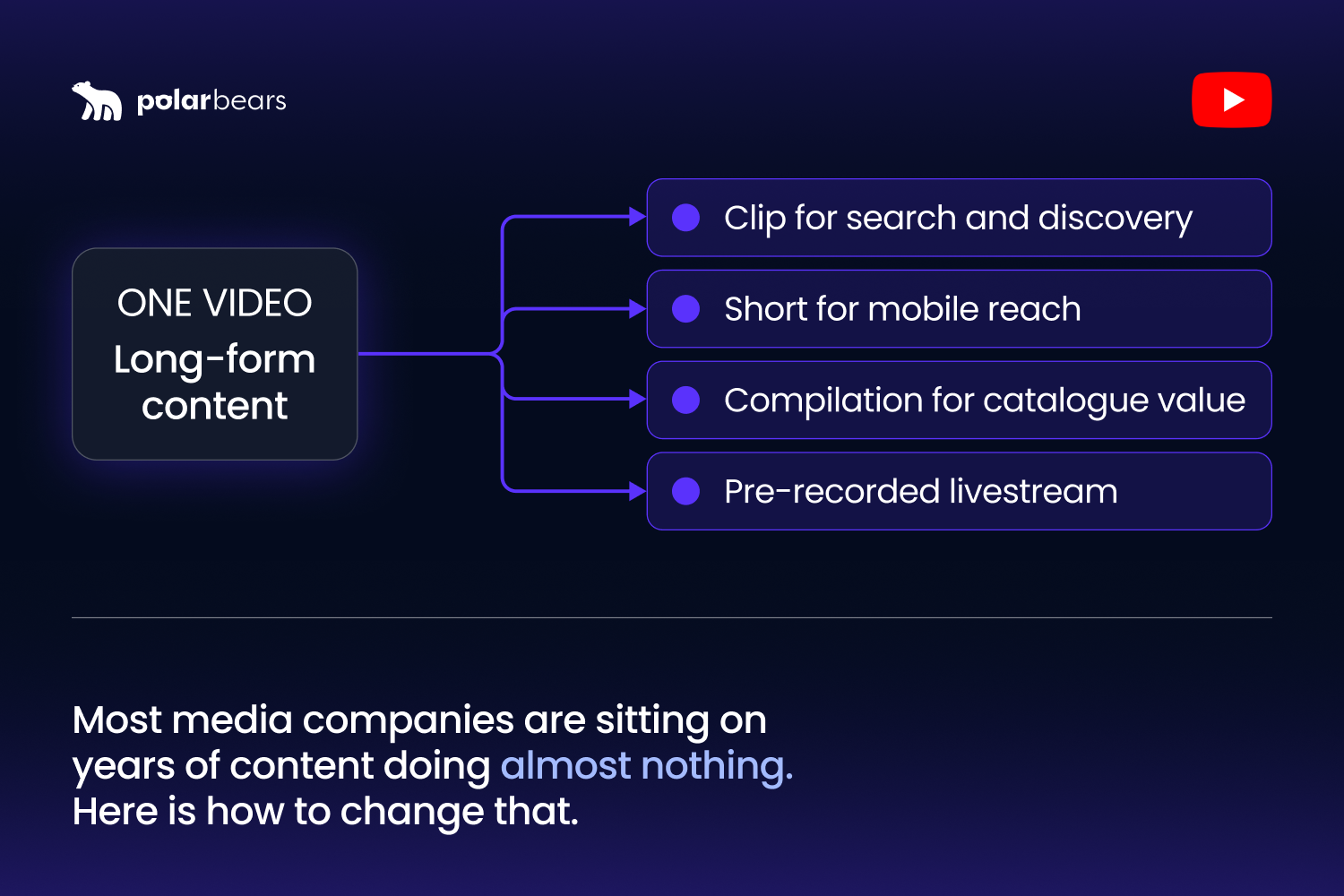
The channels growing fastest on YouTube right now are not always the ones producing the most new content. They are the ones extracting the most value from what they already have. Clips, Shorts, compilations, and always-on pre-recorded livestreams are the four formats doing the heaviest lifting. Here is how to use all of them properly.
Start with the clip
Before anything else, every long-form piece of content should be reviewed for clip potential. A clip in this context is a self-contained moment from a longer video, a sharp exchange, a surprising reveal, a strong opinion, a funny moment, anything that works as a standalone piece without needing the surrounding context to make sense.
Clips serve two purposes. They drive discovery for the original content by giving new viewers a reason to find the full version. And they populate your channel with additional indexed content that can rank independently in search and get surfaced in recommendations.
The selection criteria matter here. Do not clip the moments you think are best. Clip the moments that hook immediately, where the energy is highest or the information is most concentrated. A clip that starts slow will not survive the first three seconds in a YouTube feed.
Shorts: the highest value extraction
Shorts are the most powerful tool available to media companies on YouTube right now and the most consistently underused.
A vertical cut of your best clip moment, optimised for mobile and under 60 seconds, gets surfaced to audiences who have never seen your channel before. Shorts with strong retention, above 70 percent average, actively drive viewers back to your long-form content through algorithmic association and channel page visits. The algorithm treats a channel that uses Shorts as more active and more worthy of broader recommendation.
The common mistake is treating Shorts as an afterthought. Trimming 45 seconds from a horizontal video, uploading it vertically cropped, and calling it done. That rarely works because the pacing is wrong, the framing is wrong, and the hook is not there.
The right approach is to identify the single sharpest moment in your content and build the Short around that one point. Add text overlays that make sense without audio because a significant proportion of Shorts viewers watch on mute. If you have the capacity, re-record a tighter version of the moment rather than just cropping the original. A 45-second re-record built for the format will outperform a 45-second clip almost every time.
For media companies with large content libraries the opportunity is even bigger. Years of archive footage become a Shorts production pipeline. Broadcasters with catalogue content from sports, entertainment, news, and factual programming can extract hundreds of Shorts without commissioning a single new piece of content.
Compilations: turning clips into content
A compilation takes multiple related clips and stitches them into a single piece of content that works as a standalone video. Best moments from a series. Top plays from a season. Funniest exchanges from a show. Greatest goals from a tournament. Every broadcaster and publisher has the raw material for dozens of compilations sitting in their archive right now.
Compilations perform well for several reasons. They surface older content to new audiences who would never have found the individual episodes. They give casual viewers an accessible entry point into a catalogue they do not know well. And they generate watch time, because a well-constructed compilation keeps viewers watching in a way that a cold clip from an unfamiliar show often does not.
The key to a good compilation is curation and pacing. A compilation that feels like someone pressed shuffle on a playlist will not hold viewers. One that builds, that has a beginning, middle, and end, that rewards watching all the way through, will. Treat it like a piece of content in its own right, not just a collection of clips stuck together.
Pre-recorded livestreams: the most underused format on the platform
This is the one most media companies have never touched and the one with the most disproportionate upside.
YouTube actively favours channels that use its livestream feature. It sends signals to the algorithm that your channel is active and engaged with the platform in a way that standard uploads do not. The problem for most broadcasters and publishers is that actually going live requires resource, scheduling, and people. Pre-recorded livestreams solve that entirely.
A pre-recorded livestream is existing content, a compilation, a long-form video, an archive programme, a best-of series, scheduled to broadcast as a live event on YouTube. To the algorithm it registers as a livestream. To viewers it appears in the live section of the platform and can be watched as it plays. Once it ends it sits on your channel as a standard video.
The loop format takes this further. The same content scheduled to replay continuously means your channel always has something live. For sports channels, entertainment channels, music channels, and news channels, an always-on stream is a way to be present on the platform around the clock without a single person sitting in front of a camera.
The practical setup is straightforward. Take your best compilation or a curated selection of archive content, stitch it into a single long-form file, and schedule it as a recurring live event through YouTube Studio or a streaming tool like Restream or Streamyard. The content plays on a loop. Your channel shows as live. The algorithm treats it favourably. And viewers who find the stream can follow the channel to be notified when the next one starts.
For enterprise clients managing multiple channels, pre-recorded livestreams across every channel in the network is one of the highest-leverage things you can do for organic reach with the lowest production overhead.
The system that makes this sustainable
None of this works if it becomes a full-time job on top of everything else. The goal is a repeatable workflow where every new piece of content automatically generates clips, Shorts candidates, compilation material, and livestream assets without doubling the production workload.
That means making decisions at the point of production rather than after the fact. When filming or editing, flag the moments that work as clips. Note the Shorts candidates. Tag the archive content that belongs in a compilation. Build the repurposing into the workflow rather than treating it as a separate task that happens when someone has time.
At The Polar Bears, the repurposing pipeline is built into our distribution workflow from the start. Planning for extraction during production makes the entire process dramatically faster than going back through finished content trying to find the moments after the fact. The channels that do this properly are not working harder than the ones that do not. They are just working smarter with what they already have.
If you liked that why not take a look

Copyright Claims vs Strikes: What Brands and Broadcasters Need to Know
Copyright claims and strikes are not the same thing. What each does to your channel, when to dispute, and how brands manage copyright risk at scale.
YouTube Content ID Explained: How Rights Holders Protect and Monetise Their IP
What YouTube Content ID is, who gets access, and how rights holders use it to protect and monetise content. Payouts, policies and pitfalls explained.
What Security and Compliance Should a YouTube Agency Have?
Your agency holds your accounts and data. What SOC 2, ISO 27001, GDPR and Cyber Essentials actually mean, and what to ask before you sign.
Should Your YouTube Agency Work With Your Competitors?
Your agency might run your rival's channel too. Why agency conflict of interest matters, how good agencies keep competing clients apart, and what to ask.
What Should a YouTube Agency Put in Writing?
Most YouTube agencies dodge written commitments. What a good agency should promise: response times, reporting cadence, and fixing underperforming videos.
What Data Can You Take When You Leave a YouTube Agency?
Can you take your analytics, dashboards and custom reports when you leave a YouTube agency? What data is yours, what is not, and how to avoid lock-in.

Ready to maximise your YouTube revenue?
Get in touch and let’s begin exploring your channel’s hidden potential.