YouTube for Beginners: 10 Things You Must Know Before Starting a Channel

10 Things You Must Know Before Starting a Channel
Starting a YouTube channel costs nothing. Growing one costs time, consistency, and a willingness to be bad at something in public for longer than feels comfortable. Most channels don't fail because the creator lacked talent. They fail because the creator expected results in month two and quit by month four.
YouTube has 2.9 billion monthly active users. That's a massive audience. It's also massive competition. Over 500 hours of video get uploaded to the platform every minute. The channels that cut through that noise share a few traits that have nothing to do with camera quality or editing software.
1. Pick a niche before you pick up a camera
"I'm going to make videos about stuff I find interesting" isn't a niche. It's a journal. YouTube's algorithm needs to understand who your content is for so it can recommend it to the right people. Channels that cover one specific topic grow faster than channels that cover everything, because YouTube can match them with a defined audience.
Your niche doesn't need to be tiny. "Cooking" is too broad. "Caribbean recipes for weeknight dinners" is specific enough that the algorithm knows exactly who to show it to.
2. Your phone is good enough to start
The equipment question stops more people from starting than any other concern, and it shouldn't. A smartphone made in the last four years shoots video that's more than adequate for YouTube. The cameras on recent iPhones and Samsung devices outperform the dedicated video cameras most creators were using five years ago.
What actually matters more than your camera: audio quality. Viewers will tolerate average video quality for surprisingly long if they can hear you clearly. They'll click away from a 4K video with echo, background noise, or muffled speech in seconds. A £30 clip-on microphone is the single best first equipment investment.
3. Verify your channel immediately
Do this before you upload anything. Channel verification (just a phone number confirmation) unlocks custom thumbnails, videos longer than 15 minutes, and live streaming. Custom thumbnails alone are worth the 30 seconds it takes. Channels that use custom thumbnails get significantly higher CTR than channels using YouTube's auto-generated options, which almost always look terrible.
4. Titles and thumbnails matter more than the video itself
Uncomfortable truth: nobody sees your video unless they click on it first. The title and thumbnail are your entire marketing for every piece of content you create. A brilliant video with a weak title and default thumbnail gets zero views. A decent video with a compelling title and an eye-catching thumbnail gets thousands.
Spend 20% of your total production time on titles and thumbnails. Not 5 minutes at the end as an afterthought. If your title doesn't make someone curious and your thumbnail doesn't stand out in a feed of competing content, the video behind them never gets its chance.
5. The first 30 seconds decide everything
YouTube's data shows that most viewers decide whether to stay or leave within the opening moments of a video. If your video starts with a logo animation, a 15-second intro sequence, or "Hey guys, welcome back to my channel, today we're going to be talking about..." you're losing people before you've said anything of value.
Open with the payoff. Lead with the most interesting thing you're going to say, show, or demonstrate. Then fill in the context after you've given people a reason to keep watching.
6. Search is your best friend as a small channel
Small channels can't compete on recommendations. YouTube's algorithm recommends content from channels with established track records and proven engagement. What small channels can compete on is search.
People search YouTube constantly. It's the world's second largest search engine. If you make a video titled "How to fix a leaking tap without calling a plumber" and someone searches that phrase, your video can appear in results regardless of whether you have 50 subscribers or 500,000. Search-driven content is how small channels get their first real viewers, and those first viewers generate the engagement signals that eventually unlock algorithmic recommendations.
7. Consistency beats frequency
Posting twice a week for two months and then disappearing for three months does more damage than posting once a week for a year. YouTube's algorithm rewards channels that publish predictably. More importantly, your audience learns when to expect content. If they can't predict when you'll upload next, they stop checking.
One video per week is a solid starting cadence. If that's too much, one every two weeks works. The specific frequency matters less than the consistency. Whatever schedule you pick, stick to it for at least six months before evaluating whether YouTube is "working" for you.
8. Descriptions are not optional
Most beginners either leave the description blank or write one sentence. YouTube uses your description to understand what your video is about and match it with relevant searches. Write at least 150-200 words. Include your target keyword naturally. Add timestamps for longer videos. Link to related content on your channel.
A well-written description improves your search visibility, helps YouTube categorise your content correctly, and gives viewers additional context that can keep them engaged with your channel beyond the single video they clicked on.
9. Don't measure success by subscriber count
Subscribers are the most visible metric on YouTube and one of the least useful for understanding whether your channel is actually working. Watch time, average view duration, and click-through rate tell you far more about the health of your content.
A video that 1,000 people watch all the way through is more valuable than a video that 10,000 people click on and abandon after 15 seconds. Focus on making content that holds attention. The subscribers follow.
10. The growth timeline is longer than you think
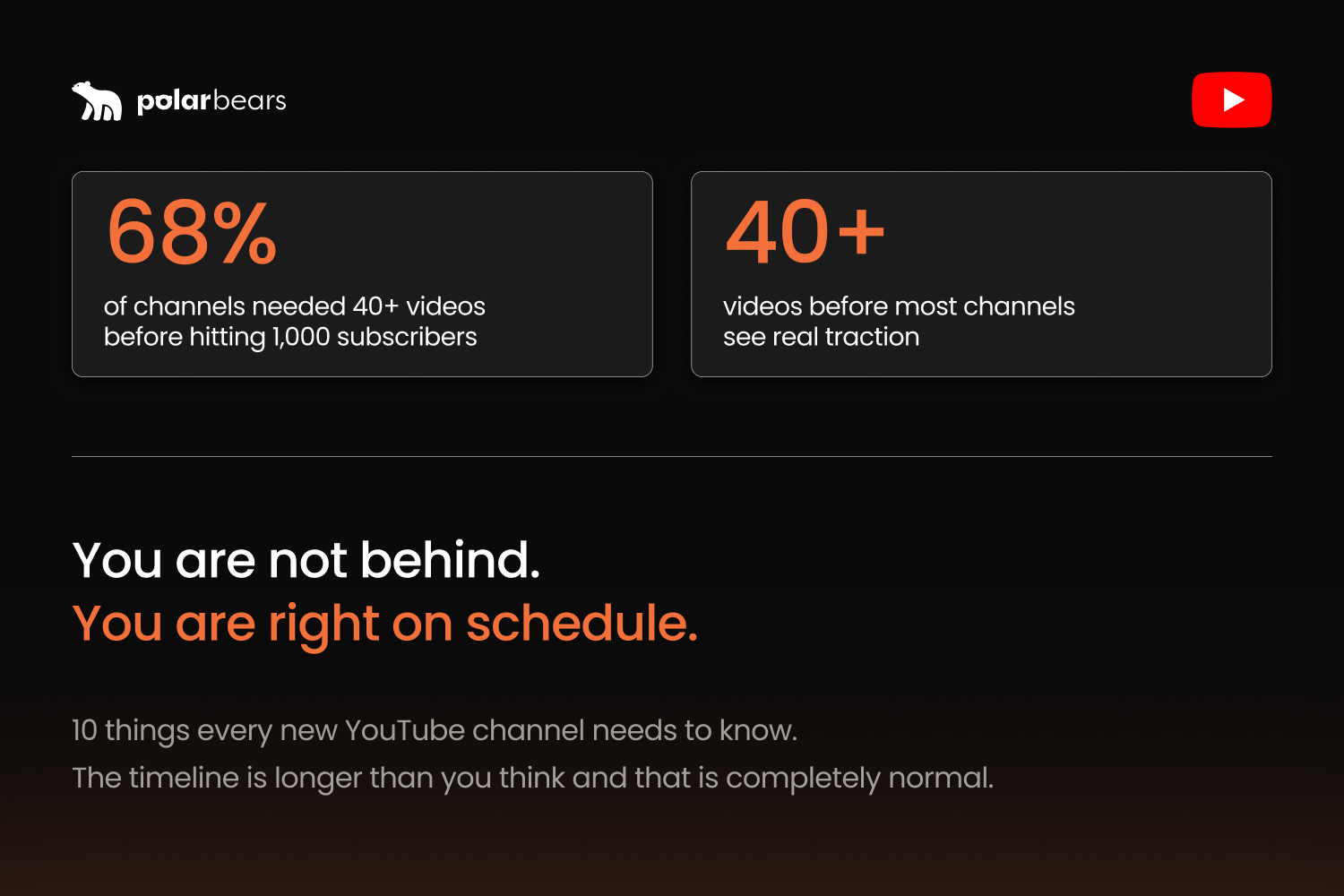
Most creators reach monetisation (1,000 subscribers and 4,000 watch hours) within 12-24 months of consistent posting. Data from over 5 million channels shows that 68% needed at least 40 videos before hitting 1,000 subscribers.
That's not a failure timeline. That's a normal timeline. The channels that feel like "overnight successes" have almost always been publishing for months or years before the moment that made them visible. If you're 20 videos in and wondering why things are slow, you're right on schedule.
At The Polar Bears, we work with channels at every stage of growth. The ones that succeed long-term almost always share one trait: they treated the first 6-12 months as an investment in learning what works, not a deadline for results.
FAQ
How do I start a YouTube channel as a beginner?
Create a Google account, set up your channel, verify your phone number (this unlocks custom thumbnails and longer uploads), choose a specific niche, and start publishing. You don't need expensive equipment. A smartphone, a £30 microphone, and natural lighting are enough to begin. Focus on consistency and search-driven topics for your first 20-30 videos.
How much does it cost to start a YouTube channel?
Nothing to set up. YouTube is free. Long-term costs depend on your content type. Most beginners can start effectively with a smartphone they already own and a £30 clip-on microphone. Editing software has free options (DaVinci Resolve, CapCut). The real investment is time, not money.
How can a beginner make money on YouTube?
Join the YouTube Partner Programme once you reach 1,000 subscribers and 4,000 watch hours (or 10 million Shorts views in 90 days). At 500 subscribers with 3,000 watch hours, you unlock fan funding features like Super Thanks and memberships. Beyond ads, creators earn through sponsorships, affiliate marketing, merchandise, and digital products.
What equipment do I need to start YouTube?
A smartphone (2020 or newer), a clip-on or USB microphone (£20-£50), and good natural lighting. That's it for starting. Upgrade to a dedicated camera, ring light, and editing software once you've proven you enjoy the process and plan to continue. Don't buy expensive gear before you've uploaded your first 10 videos.
How long does it take to grow a YouTube channel?
Most creators see meaningful traction within 30-90 days of consistent, niche-focused publishing. Monetisation typically takes 12-24 months. Data shows 68% of channels needed at least 40 videos before reaching 1,000 subscribers. The timeline depends heavily on niche, content quality, and publishing consistency.
What is the difference between a YouTube account and a YouTube channel?
A YouTube account is your Google account that gives you access to YouTube. A YouTube channel is your specific presence on the platform where you upload videos, create playlists, and where viewers subscribe. One Google account can manage multiple YouTube channels.
Starting a channel and want to get the foundations right?
If you liked that why not take a look

Copyright Claims vs Strikes: What Brands and Broadcasters Need to Know
Copyright claims and strikes are not the same thing. What each does to your channel, when to dispute, and how brands manage copyright risk at scale.
YouTube Content ID Explained: How Rights Holders Protect and Monetise Their IP
What YouTube Content ID is, who gets access, and how rights holders use it to protect and monetise content. Payouts, policies and pitfalls explained.
What Security and Compliance Should a YouTube Agency Have?
Your agency holds your accounts and data. What SOC 2, ISO 27001, GDPR and Cyber Essentials actually mean, and what to ask before you sign.
Should Your YouTube Agency Work With Your Competitors?
Your agency might run your rival's channel too. Why agency conflict of interest matters, how good agencies keep competing clients apart, and what to ask.
What Should a YouTube Agency Put in Writing?
Most YouTube agencies dodge written commitments. What a good agency should promise: response times, reporting cadence, and fixing underperforming videos.
What Data Can You Take When You Leave a YouTube Agency?
Can you take your analytics, dashboards and custom reports when you leave a YouTube agency? What data is yours, what is not, and how to avoid lock-in.

Ready to maximise your YouTube revenue?
Get in touch and let’s begin exploring your channel’s hidden potential.