How To Switch YouTube Agencies Without Losing Channel Performance

How To Switch YouTube Agencies Without Losing Channel Performance
A lot of brands stay with an agency they have outgrown out of fear. Fear that the moment they switch, the growth stops, the rankings drop, and months of progress disappear. So they stay put, paying for a service that stopped working a while ago.
Here is the thing, your channel's performance does not live in the agency. It lives in the channel. The videos, the titles and thumbnails, the back catalogue, the subscribers, the audience YouTube has learned to show your content to. None of that belongs to the agency, and none of it changes because you changed the team managing it. Handle the switch well and a well-documented transition usually settles within about 90 days with no real loss.
This guide covers what actually causes a drop, what to lock down before you give notice, what to take with you, and how to time the whole thing so the move is boring instead of painful.
Why switching is less risky than it feels
It helps to be clear about what an agency is, and is not. An agency is a team that operates your channel. It is not the channel itself. When the team leaves, your videos stay, your subscribers stay, and your standing with the algorithm stays. A new team picks up the same assets and carries on.
So the real question is not "will switching hurt my channel," but "will the handover be clean." That is a process you control, which is a much better position than the helpless one the fear assumes.
What actually causes a performance drop
When a channel does dip after a switch, the cause is almost never the decision. It is the handover. A rushed, undocumented handover that leaves the new team guessing at what was built and why is what does the damage, not the act of changing agency.
Picture the new team inheriting a channel with no notes. They do not know which formats were tested, which thumbnails won, why the schedule looks the way it does, or what the last agency was midway through. So they guess, and guessing is where momentum gets lost. Avoid that one thing and you have avoided nearly all of the risk. Everything below is built to avoid it.
Before you give notice: lock down access and ownership
This is the step people get wrong, and it is the most important one. Sort out access and ownership before you tell your current agency you are leaving, not after.
Confirm you are the owner
You should be the registered owner of your channel and the Google account behind it. That means you are the person the account legally belongs to, not the agency. If your current agency set the channel up under its own account, you control nothing, and you need to transfer ownership to yourself first. Trying to do this after you have given notice is how brands end up locked out of their own channel.
Get full access yourself
Make sure you personally hold full access to everything before notice goes in. Your channel and YouTube Studio (the management back end), your analytics, your ad accounts and AdSense (where your ad money is paid out), and any third-party tools. Once you have your own access, the old agency cannot accidentally, or deliberately, cut you off mid-exit.
Take everything that is yours
Before the relationship ends, get copies of the things that took months to build. Your full analytics history, so the new team can see what happened and when. Your current performance data as a baseline. Your content records, including which titles, thumbnails, and topics were tested and how they did.
This is also where a good agency setup pays off, because the data was built to be portable in the first place. At The Polar Bears the reporting sits in a platform Powered by Vixxi, the platform we license to consolidate YouTube, Google Ads, and Google Ad Manager into one workflow, and that history belongs to the client, so leaving with it is simple rather than a fight. If your current agency cannot hand your own data back cleanly, that tells you something about why you are leaving. Our guide to the metrics that actually matter is a good checklist of what to make sure you take.
Run an overlap, do not cut over cold
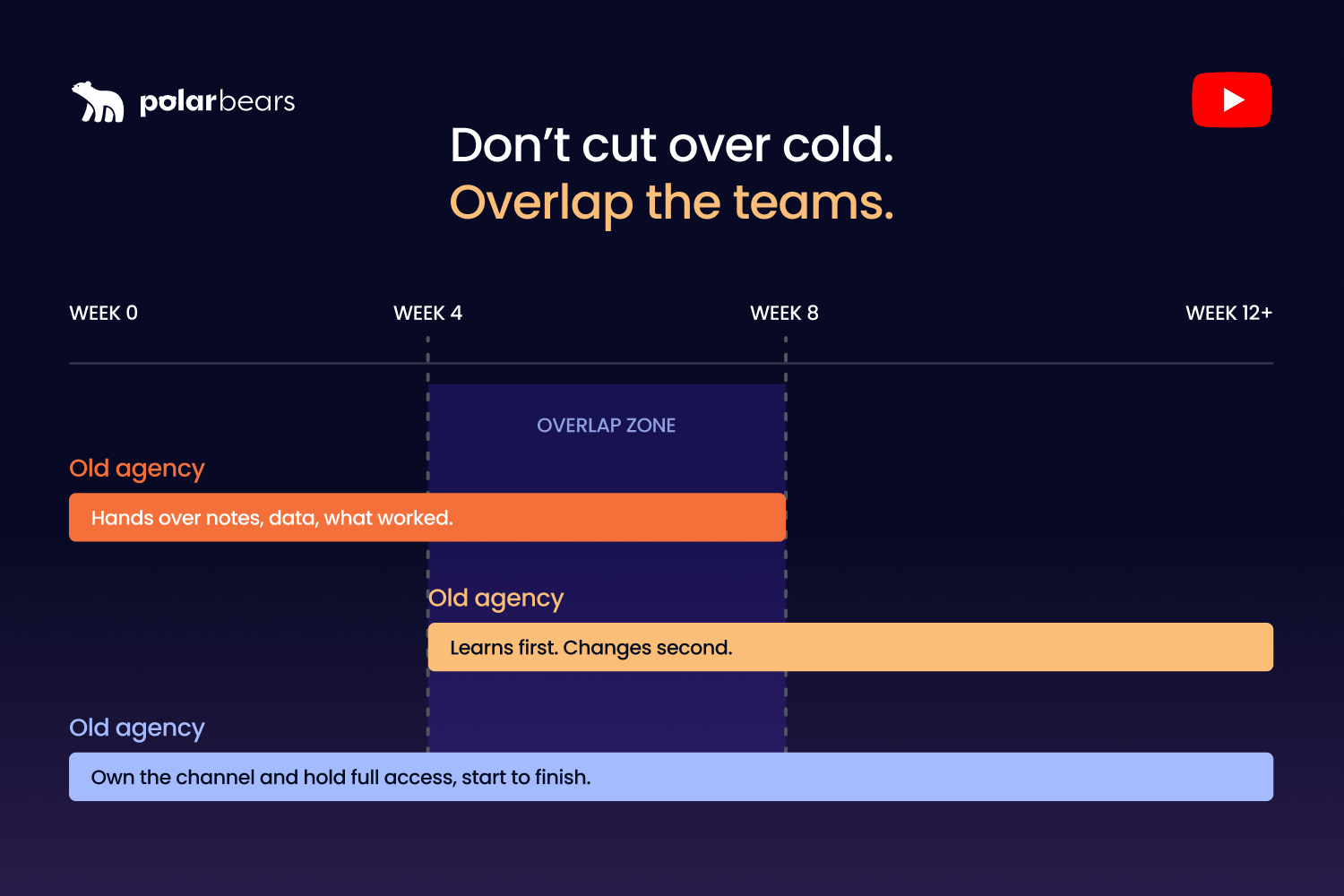
The cleanest switches are not a hard stop on a Friday and a cold start on a Monday. They overlap. A sensible plan keeps both agencies operational for a short window, usually four to eight weeks, so the new team can absorb what the old one knew before the old one walks out the door.
Yes, that overlap costs a little more for a few weeks. It is cheap insurance against the management gap that causes the dip in the first place. Thirty days is the minimum worth doing. Sixty is better if your setup is complex, like a multi-channel network or a broadcaster running several feeds.
Hold the new agency back at first
Good new agencies want to make their mark, and that instinct is the risk. Ask them not to rip everything up on day one. The first 60 to 90 days should be about understanding what is already working and why, before changing it.
Aggressive changes too early, new thumbnails on everything, a reshuffled schedule, a rewritten back catalogue, can undo what was quietly performing. A confident new team is happy to learn first and change second, the same disciplined start we describe in our onboarding guide. If a new agency wants to tear it all down in week one, that is its own warning sign.
Time it right
Pick your moment. Avoid switching during your busiest season if you possibly can. Even a well-run transition involves some disruption and a dip in output, and that disruption hurts most when your channel matters most, like a product launch window, a sports season, or a festive peak.
If your contract has a notice period or a renewal date, plan the move around it so you are not paying two agencies longer than you need to, or stuck paying the old one past the point it is useful. A little planning here saves real money, the kind we break down in our look at what channel management costs.
Switching cleanly
Put it together and switching is far less frightening than staying somewhere that has stopped delivering. Own your channel, hold your own access, take your data, overlap the teams, hold the new agency back at first, and time it away from your peak. Do those six things and the channel barely notices the change.
The brands that switch to us rarely lose a step, because we treat the handover as the job, not an afterthought. At The Polar Bears we manage over two million videos, and onboarding a switched channel cleanly is something we do all the time. For the broadcasters and publishers we work with, a careful handover is the difference between a switch they worried about and one they barely felt.
FAQ
Can you switch YouTube agencies without losing performance?
Yes. Your performance lives in the channel itself, the videos, subscribers, and audience, not in the agency, so changing the team does not change the channel. A well-documented handover usually settles within about 90 days with no real loss. The risk comes from a rushed switch, not the decision.
Will changing agencies hurt my channel?
Only if the handover is rushed and undocumented. A clean switch, where you keep ownership and access, hand over your data and notes, and let the new team learn before making big changes, protects the channel. The dip people fear comes from a guessing new team, which good planning prevents.
What do I need before leaving my current YouTube agency?
Confirm you are the registered owner of the channel and Google account, make sure you personally hold full access to the channel, Studio, analytics, and AdSense, and get copies of your analytics history and content records. Sort all of this before you give notice, not after.
How long does switching YouTube agencies take?
Plan for an overlap of about four to eight weeks where both agencies operate, then 60 to 90 days for the new team to learn before making major changes. A well-run transition usually stabilises within 90 days, longer if your setup is complex, like a multi-channel network.
Should the old and new agency overlap?
Yes, where you can. A short overlap, usually four to eight weeks, lets the new team absorb what the old one knew before they leave. It costs a little more for a few weeks, but it prevents the management gap that causes most performance dips during a switch.
When is the best time to switch agencies?
Away from your busiest season. A transition always involves some disruption, and that hurts most during a launch, a sports season, or a festive peak. Plan the move around your contract's notice period and renewal date so you are not paying two agencies longer than needed.
Want to switch agencies without a dip in performance?
If you liked that why not take a look

Copyright Claims vs Strikes: What Brands and Broadcasters Need to Know
Copyright claims and strikes are not the same thing. What each does to your channel, when to dispute, and how brands manage copyright risk at scale.
YouTube Content ID Explained: How Rights Holders Protect and Monetise Their IP
What YouTube Content ID is, who gets access, and how rights holders use it to protect and monetise content. Payouts, policies and pitfalls explained.
What Security and Compliance Should a YouTube Agency Have?
Your agency holds your accounts and data. What SOC 2, ISO 27001, GDPR and Cyber Essentials actually mean, and what to ask before you sign.
Should Your YouTube Agency Work With Your Competitors?
Your agency might run your rival's channel too. Why agency conflict of interest matters, how good agencies keep competing clients apart, and what to ask.
What Should a YouTube Agency Put in Writing?
Most YouTube agencies dodge written commitments. What a good agency should promise: response times, reporting cadence, and fixing underperforming videos.
What Data Can You Take When You Leave a YouTube Agency?
Can you take your analytics, dashboards and custom reports when you leave a YouTube agency? What data is yours, what is not, and how to avoid lock-in.

Ready to maximise your YouTube revenue?
Get in touch and let’s begin exploring your channel’s hidden potential.