Long-form vs Shorts: YouTube Distribution Strategy 2026

Long-form vs Shorts
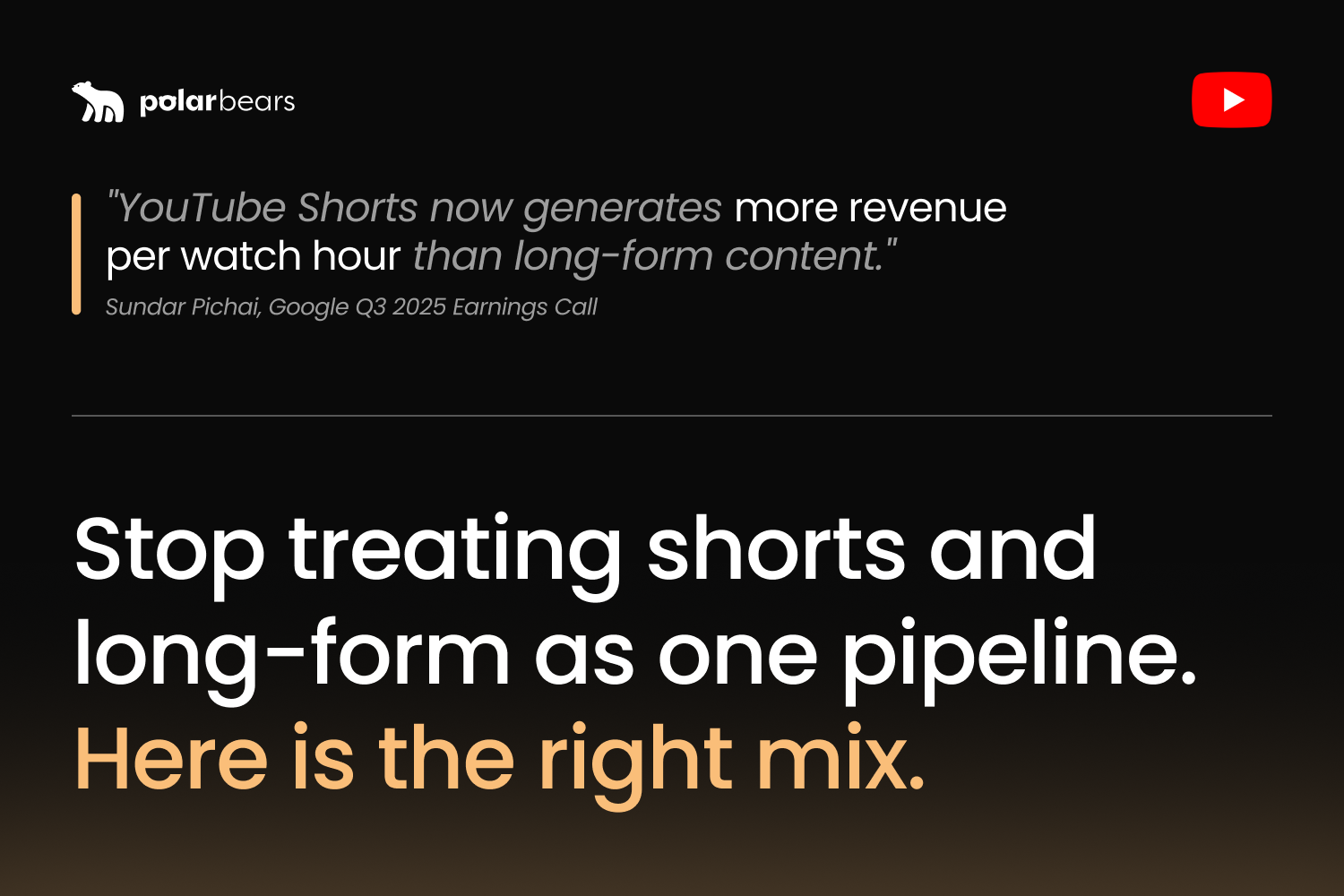
On 29 October 2025, on Google's Q3 earnings call, Sundar Pichai said something that reset YouTube planning for every brand on the platform.
YouTube Shorts now generates more revenue per watch hour than long-form content.
For three years before that, the consensus had been the opposite. Long-form was the revenue engine. Shorts were the discovery hook. But his single statement flipped everything.
If you're a head of social, a brand marketing director, or running content for a broadcaster or production company, your planning question for 2026 is no longer "are Shorts worth it?".
It's "what's the right mix, and how do we actually run both?"
What actually changed in Q3 2025
The Pichai statement came on Google's Q3 2025 earnings call. YouTube ad revenue for the quarter was $10.26 billion, up 15% year on year. The driver: Shorts.
Three things changed at once over 2025.
The first was ad load. YouTube quietly increased the number of ads served in the Shorts feed through 2025. More ads, more inventory, more revenue.
The second was brand demand. Brands started buying Shorts ads at scale. Tubefilter reports a steady rise in sponsored Shorts on tracked channels through 2025. The branded-Shorts category went from experimental to standard.
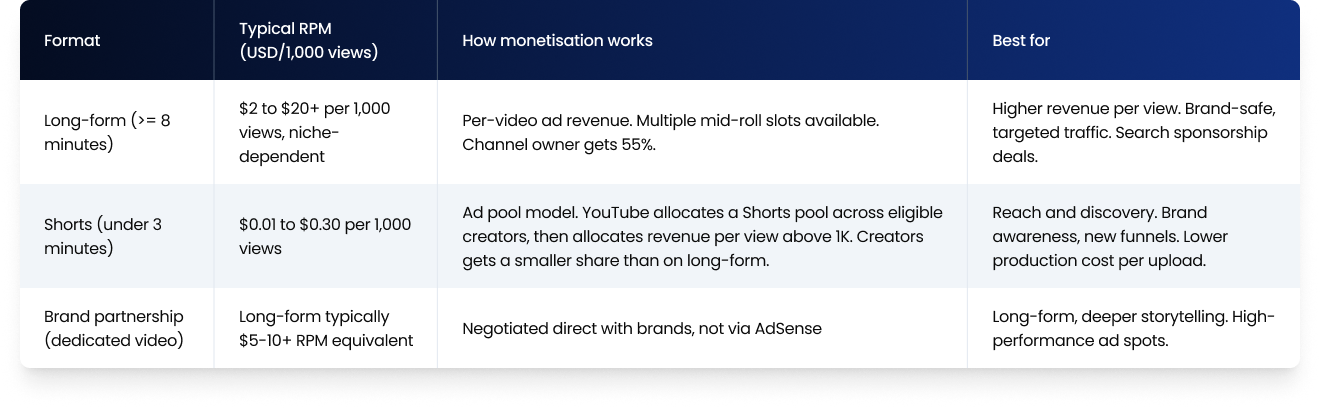
The third was the revenue split. On long-form, the channel owner gets 55% of ad revenue and YouTube takes 45%. On Shorts, the share is less generous to creators. So even when creator RPM is similar, YouTube earns more per watch hour.
Read the Pichai statement carefully. He said Shorts make YouTube more per watch hour. He did not say Shorts make creators more per watch hour. The creator-side gap still exists. But the trajectory is clear: YouTube is investing in Shorts, brands are spending on Shorts, and the platform's incentives now lean towards a strong Shorts feed.
That has implications for your strategy whether you upload Shorts or not.
How the economics actually work in 2026
Most pieces on this topic compare RPM with a single number. The reality is messier. Here's the honest version.
Two updates from 2025 to factor in.
The first is length. Shorts can now be up to three minutes long. YouTube extended the cap from 60 seconds in 2025. That blurs the line between Shorts and long-form, but the algorithm still rewards high completion rates. A 3-minute Short where most viewers drop off at 45 seconds underperforms a 30-second Short watched all the way through.
The second is how views are counted. The view count rule changed on 31 March 2025. Any Short that starts playing now counts as a view. Replays count as separate views. That inflated raw view counts overnight. YouTube introduced "engaged views" as the metric that actually matters for Partner Programme thresholds and revenue. If you're measuring Shorts performance using raw views, you're measuring the wrong thing.
The economic picture for 2026: long-form still pays creators more per view, but Shorts have closed enough of the gap to be worth proper investment, especially as part of a brand strategy that values reach as well as revenue.
Why long-form and Shorts are now two separate operations
This is where most brand strategies are still stuck in 2024.
The old model: post Shorts to feed your long-form channel. Use Shorts as a top-of-funnel hook. Repurpose clips from long-form videos. Treat the whole thing as one content pipeline.
The new model in 2026: run them as two operations.
The Shorts recommendation system uses different signals from long-form. Shorts is judged on swipe-through rate, loop rate, replay count, and engagement in the first three seconds. Long-form is judged on click-through rate, watch time, audience retention, and viewer satisfaction signals (post-watch surveys, session continuation, return visits).
Industry analysis through late 2025 strongly suggests Shorts performance no longer affects long-form recommendations and vice versa. YouTube has not officially announced a "decoupling," so technically this remains an observed pattern. But the data from creators and trade analysts (OutlierKit, vidIQ, Shortimize) is consistent enough that planning around it is the safe call.
What this means in practice for brands and broadcasters:
You can run a heavy Shorts strategy without worrying it will hurt your long-form. The opposite is also true. If your Shorts are taking off, that growth will not automatically translate to more long-form viewers. You have to actively bridge them, and even then the conversion rate is far from 1:1.
The "Shorts trap" is real: channels that build a large Shorts subscriber base often see weak long-form retention because Shorts subscribers came in for short-form content and don't engage with longer videos the same way. Bridging works best when Shorts have explicit links to specific long-form videos, not just generic "go watch our channel" CTAs.
The strategic implication: stop expecting your Shorts effort to grow your long-form for free. Plan and budget for them separately.
How to decide your mix: four questions
Most articles on this topic recommend a fixed ratio. 70/30 long-form to Shorts. 80/20. 50/50. None of those numbers come from primary data. They come from someone's gut feel.
The right ratio depends on your specific business. Four questions to work through.
What is your goal?
If your goal is direct revenue, weight towards long-form. Per-view revenue is higher, brand sponsorship deals are bigger, and search-driven evergreen traffic compounds over time.
If your goal is reach (audience awareness, top-of-funnel discovery), weight towards Shorts. The Shorts feed surfaces content to viewers who don't follow you, which is exactly what reach goals need.
Most brands need both. The mix depends on which goal is currently more important.
What does your IP actually look like?
If you have a deep archive of long-form content (a broadcaster, a production company with a back catalogue, a brand with years of video assets), long-form should be a major part of your strategy. Archive monetisation is one of the highest-margin opportunities on YouTube because the content is already made.
If your IP is mostly new and short (a brand creating fresh assets monthly), Shorts can be a faster route to traction because the production cost per upload is lower.
What is your production capacity?
A serious long-form operation produces one to four high-quality long-form videos per month. A serious Shorts operation produces 15 to 60 Shorts per month. Those are different workflows, different team structures, and different briefing processes.
If your team can only sustain one of those volumes, choose accordingly. Trying to do both at half-capacity usually means doing both badly.
Where does your audience actually watch?
If your buyer persona is older, more research-driven, and uses YouTube via desktop or smart TV, weight towards long-form. That audience watches long videos. They click search results. They use YouTube the way they used to use cable.
If your audience is under 30, mobile-first, and discovers content through feed-based scrolling, weight towards Shorts. That audience is more likely to find you through the Shorts feed than through search.
The honest answer is rarely 70/30 or 50/50. It's whatever combination of these four factors actually applies to your business.
Where brands and broadcasters get this wrong
Five specific mistakes show up in strategies that fail.
The first is automated repurposing. Tools that chop long-form videos into Shorts using AI are everywhere. They are useful for raw production efficiency but the output rarely performs. A 30-second clip pulled from a 20-minute video usually has no hook, no payoff, and no reason to watch. Shorts that perform are conceived as Shorts from the start.
The second is the Shorts trap. A channel posts Shorts aggressively, builds a large subscriber base, then notices long-form retention plummets. The fix is not to stop posting Shorts. It is to stop expecting Shorts subscribers to behave like long-form subscribers. They came in for one thing. They will mostly stay for that one thing.
The third is treating both formats as one workstream. The same producer commissioning both, the same editor cutting both, the same dashboard measuring both. Each format has different success criteria. Mixing them in one workflow makes it harder to optimise either.
The fourth is ignoring Shorts because the per-view revenue is low. This was a defensible position in 2023. After Pichai's Q3 2025 statement, it is not. Brand reach goals matter, brand sponsorship deals on Shorts are growing, and YouTube's algorithm is actively investing in the Shorts feed.
The fifth is the opposite mistake: ignoring long-form because Shorts feel easier. Long-form remains the highest-revenue format on YouTube, and search-driven evergreen traffic is still where most B2B and educational channels make most of their money.
How to run both well
When you commit to running both, three operational questions need clear answers.
Two teams, or one team with two workflows?
Smaller operations (under 30 videos a month total across both formats) can run with one team and two well-defined workflows. Briefing, production, optimisation, and review are different for each format, but the team can hold both.
Larger operations (broadcasters, multi-channel brands, production companies with archive monetisation) usually benefit from separate Shorts and long-form pods. The Shorts pod operates on faster cycle times and different briefs. The long-form pod operates on production schedules closer to traditional broadcast.
Repurposing: when it works, when it doesn't
Repurposing works when the long-form video has a genuinely standalone moment that can carry as a Short. A surprising stat. A counterintuitive claim. A clean visual demo. A clip with self-contained tension and payoff.
Repurposing does not work when the Short is just "the first 30 seconds" of a long-form video, or a random highlight extracted by an AI tool. Those Shorts have no narrative shape and no reason to be watched.
A working rule of thumb: every Short needs a standalone hook in its first three seconds, a clear value or payoff, and a reason to either replay or click through. If the repurposed clip does not have those, write a Short from scratch.
Tooling that separates them properly
When you run long-form and Shorts as two operations, you need analytics that separate them too. YouTube Studio shows them in one combined view by default, and the 50-video custom dashboard cap is blocking once you cross any meaningful production volume. Purpose-built tooling becomes mandatory at this point. Vixxi, the YouTube intelligence platform built by The Polar Bears, pulls Shorts and long-form data into separate views with their own RPM tracking, custom fields, and full-catalogue access (RPM means revenue per thousand views).
For more on the operational layer underneath all of this, the TPB YouTube Distribution solution page covers what running both at broadcaster scale looks like in practice.
FAQ
Do Shorts now make more money than long-form?
For YouTube, yes (per watch hour). For creators, no (per view). On Google's Q3 2025 earnings call, Sundar Pichai said Shorts now generates more revenue per watch hour than long-form for YouTube. That reflects increased ad load on Shorts, brand demand, and YouTube's revenue share. Creator-side RPM is still lower on Shorts than on long-form, sometimes by a factor of 10 to 100.
Should I do Shorts or long-form?
For most brands and broadcasters, both. The right mix depends on four things: your goal (revenue or reach), your IP (archive heavy or new content), your production capacity, and where your audience watches. Brands focused on revenue and search traffic should weight towards long-form. Brands focused on reach and brand awareness should weight towards Shorts. Most need a blend.
Should I turn my long-form videos into Shorts?
Sometimes. Repurposing works when the long-form video has a self-contained moment that can carry as a Short: a surprising stat, a counterintuitive claim, a clean visual. Repurposing does not work when the Short is just the first 30 seconds of a longer video. AI-driven repurposing tools are useful for production efficiency but their output rarely performs. The best Shorts are conceived as Shorts from the start.
How long can YouTube Shorts be in 2026?
Up to 3 minutes. YouTube extended the Shorts length cap from 60 seconds in 2025. The cap is now 3 minutes, but the algorithm still rewards high completion rates. A 30-second Short watched all the way through will usually outperform a 3-minute Short where most viewers drop off at 45 seconds.
Do longer Shorts earn more?
Not directly. Shorts revenue is calculated through an ad pool model based on view share, not per-second of watch time. A longer Short does not automatically earn more. What earns more is engaged views (viewers who actually watch beyond a brief instant or interact with the video) and consistent retention. A 60-second Short with 80% completion will typically out-earn a 3-minute Short with 30% completion.
How does the YouTube Shorts algorithm work in 2026?
The Shorts algorithm uses an explore-and-exploit model. Every new Short is tested against a small seed audience. If they watch through, replay, or engage, it gets pushed to progressively larger audiences. If they swipe away, distribution stops. Key signals are swipe-through rate (do viewers keep watching or swipe away), loop rate, replay count, and engagement in the first few seconds. Click-through rate (a major long-form signal) does not apply to Shorts because viewers swipe rather than click.
Are Shorts and long-form on separate algorithms?
Industry analysis strongly suggests they are. Through late 2025, multiple trade analysts (OutlierKit, vidIQ, Shortimize) reported that Shorts and long-form recommendations now operate independently — your Shorts performance no longer affects long-form recommendations and vice versa. YouTube has not officially announced this as a formal change, so technically it remains an observed industry pattern. The verifiable reality: the two formats use fundamentally different signals (swipe-through and loop rate vs. watch time and satisfaction), which is why most strategists now plan them as separate operations.
Want to talk through your long-form and Shorts strategy?
If you liked that why not take a look

Copyright Claims vs Strikes: What Brands and Broadcasters Need to Know
Copyright claims and strikes are not the same thing. What each does to your channel, when to dispute, and how brands manage copyright risk at scale.
YouTube Content ID Explained: How Rights Holders Protect and Monetise Their IP
What YouTube Content ID is, who gets access, and how rights holders use it to protect and monetise content. Payouts, policies and pitfalls explained.
What Security and Compliance Should a YouTube Agency Have?
Your agency holds your accounts and data. What SOC 2, ISO 27001, GDPR and Cyber Essentials actually mean, and what to ask before you sign.
Should Your YouTube Agency Work With Your Competitors?
Your agency might run your rival's channel too. Why agency conflict of interest matters, how good agencies keep competing clients apart, and what to ask.
What Should a YouTube Agency Put in Writing?
Most YouTube agencies dodge written commitments. What a good agency should promise: response times, reporting cadence, and fixing underperforming videos.
What Data Can You Take When You Leave a YouTube Agency?
Can you take your analytics, dashboards and custom reports when you leave a YouTube agency? What data is yours, what is not, and how to avoid lock-in.

Ready to maximise your YouTube revenue?
Get in touch and let’s begin exploring your channel’s hidden potential.