The Hidden Cost of Doing YouTube Operations In-House

The Hidden Cost of Doing YouTube Operations In-House
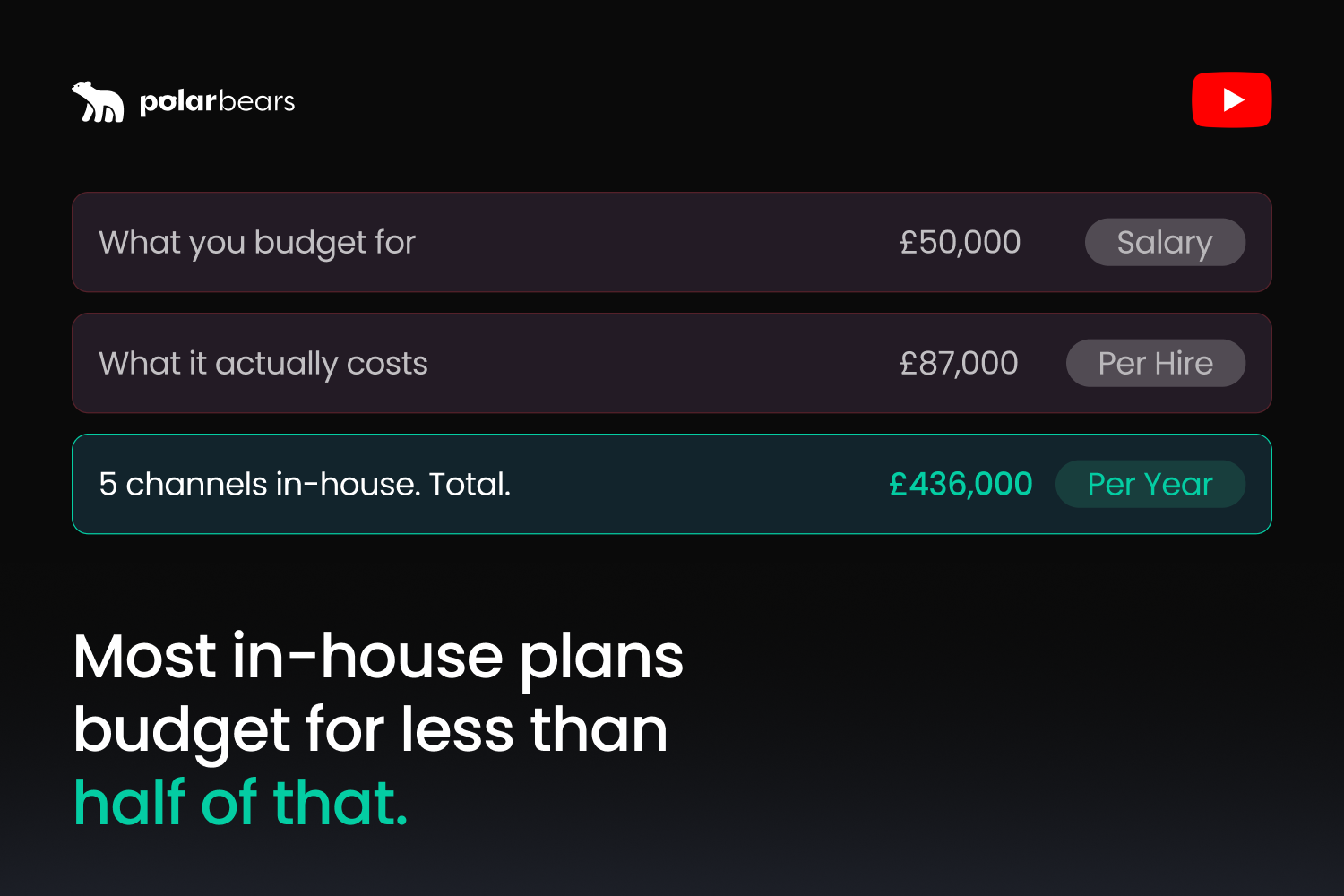
Most companies hiring for YouTube in-house budget for the base salary and stop there. The real fully-loaded cost is closer to 1.5× that number. Sometimes 1.7×.
And that's before you've added the tool and software stack, recruitment fees, the cost of replacing them when they leave 18 months later or the risk of one person being your entire YouTube team.
If you're a head of digital, marketing director, or founder weighing up an in-house YouTube hire against an agency, the maths gets uncomfortable once you actually run them.
So here's the proper calculation, with UK numbers verified against HMRC, Glassdoor, and CIPD.
The published salary is half the real cost
Look up YouTube Channel Manager salaries on Glassdoor UK and the median is £49,000, with a typical range of £39k to £62 (as of April 2026).
Those figures come from 141 self-reported salaries in March 2026. They are broadly accurate.
But that is the salary line. Not the cost line.
The salary is what hits the employee's bank account. The cost is what hits your P&L. The two numbers diverge because of statutory employer contributions, benefits, and overheads that most in-house plans ignore until the first quarter's payroll lands.
The five hidden cost categories most in-house plans miss
Employer National Insurance and pension
This one is the simplest. Since April 2025, employer National Insurance is 15% on employee earnings above £5,000 per year. The rate is unchanged for the 2026/27 tax year.
On a £51,418 Channel Manager salary, that means £6,963 a year in employer NI alone. Before you've spent a penny on anything else.
Pension auto-enrolment adds another 3% employer contribution on qualifying earnings, which sits between £6,240 and £50,270. For the same salary, that adds roughly £1,320 a year.
Statutory contributions alone add about 16% to the salary cost. A £51,418 base becomes £59,701 before the optional stuff begins.
Benefits, equipment, office, training
Most mid-level marketing roles in the UK come with a benefits package costing the employer 5% to 15% of base salary. Private medical insurance, life insurance, sometimes income protection. For a £51,418 role at the middle of that range, that is £3,000 to £5,000 a year.
Equipment is smaller but adds up. Laptop, monitor, software licences, peripherals. Amortised over a 3-year refresh cycle, that is £300 to £500 a year per head.
Office space depends on where you are. London serviced or hybrid space usually costs £5,700 to £9,660 per head per year. Manchester, Birmingham, and other regional hubs are roughly half that.
Training and development budgets average £500 to £2,000 per employee per year. Specialist YouTube skills push the higher end of that range. Algorithm fluency, retention editing, and CMS work all need ongoing learning.
Add it all up and the typical fully-loaded multiplier is 1.4 to 1.7× the base salary. A £51,418 Channel Manager actually costs the employer around £75,000 to £87,000 a year in total.
The tooling stack
Most in-house plans budget for the team and treat tooling as an afterthought. At 5+ channels, that becomes blocking quickly.
The stack you actually need covers five jobs. Multi-channel platforms (TubeBuddy Enterprise or VidIQ) for bulk metadata editing across channels. Portfolio analytics (Tubular Labs or similar), needed because YouTube Studio caps custom dashboards at 50 videos and exports at 500. Workflow tools (ClickUp, Asana, or Notion) for cross-channel calendars and approvals. Localisation tools (HeyGen, Descript) for multi-language dubbing. Stock libraries (Storyblocks, Epidemic Sound) for footage and music.
Realistic annual totals based on published 2026 pricing:

This is a budget line most in-house plans only discover after they have hired. By then the cost is already locked in.
Recruitment cost
Hiring is not free. UK marketing recruitment agencies usually charge 15% to 25% of first-year salary for permanent placements. For specialist YouTube roles, that creeps up to 20% to 30% because the talent pool is small.
A £51,418 Channel Manager hire through an agency costs roughly £10,000 to £12,000 in fees alone. That is before factoring in the time-to-hire delay.
Specialist YouTube ops roles in 2026 usually take 8 to 16 weeks to fill. During those weeks, the work either piles onto existing staff (lost productivity), goes undone (lost revenue), or gets temporarily outsourced (extra cost). All three options have a price.
Turnover and replacement cost
This is where most in-house budgets break.
YouTube and social media specialist roles have higher turnover than general marketing. Average tenure is roughly 18 to 24 months, against around 3 years for broader marketing roles. Two big drivers behind the gap. The talent pool is small and competitive, with the creator economy and agencies bidding against in-house roles for the same people. And the work itself is intense at multi-channel scale.
CIPD research on resourcing and talent puts the cost of replacing an employee at 75% to 200% of their base salary, depending on role complexity. That covers recruitment fees, onboarding time, training, lost productivity during the gap, and the temporary stretching of remaining staff.
For a £51,418 role, that is £38,000 to £100,000 in replacement cost every time someone leaves. If you are losing one person every 18 to 24 months, that is a recurring line, not a one-off.
The cheapest cost line on paper is also the most expensive in practice when it goes wrong. If one person owns your YouTube workflow, their departure stalls the entire function. Documentation rarely happens, because the person doing the work does not have time to write it down. The most common in-house YouTube failure pattern is the "hired in March, gone by November" arc. Six months of onboarding. Three months of productive work. Two months of decline as they start interviewing elsewhere. Then the replacement search starts again.
The full maths for 5 channels in-house
Pulling all of that together for a working 5-channel in-house operation:
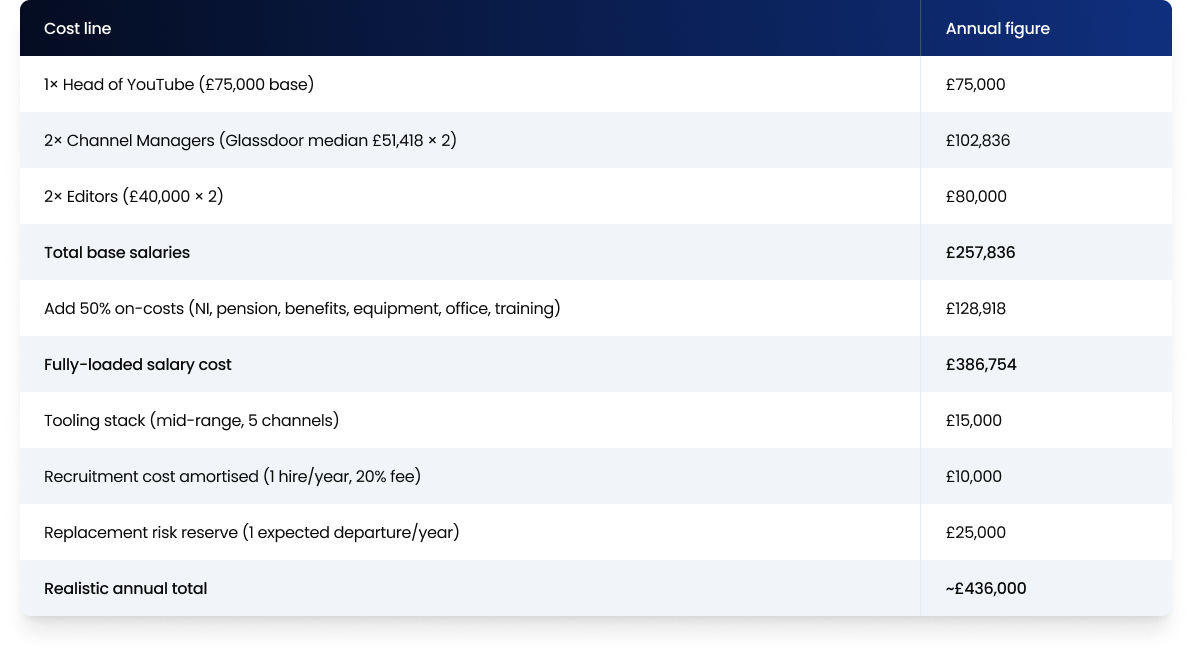
That is the budget line your CFO actually needs to see, not just the salaries on a job description page.
For 10 channels, double the team and most of the costs roughly double too. Realistic annual total: £750,000 to £900,000.
These numbers turn the in-house vs agency decision from a vibes call into an arithmetic problem.
When in-house IS the right call
Despite the maths, real situations exist where in-house is the right answer.
A brand voice that needs full-time editorial ownership. Some brands and broadcasters have a distinctive editorial voice that genuinely requires daily in-house judgement. If your YouTube content is a creative product as much as an operational one, the cost premium for in-house is worth it.
A genuine internal talent pipeline. Some larger media companies hire YouTube ops people from their existing graduate or junior schemes. If you can recruit and develop talent internally, the recruitment and turnover lines on the budget shrink dramatically.
A small, stable channel count. If you run one or two channels with no plans to scale, the risk to operations of single-point-of-failure is lower. One person can hold the whole function in their head.
Compliance, security, or rights-sensitivity. Some broadcasters and rights holders have content that genuinely cannot leave the building. In-house is the only option if external access is restricted.
If two or more of those apply, an in-house build can absolutely make sense. The case above is not an argument against in-house. It is an argument against doing the maths wrong.
When an agency or hybrid model wins
For most brands and broadcasters running 5+ channels in 2026, the maths favours an agency or hybrid model.
TPB distribution packages start at £1,100 a month for around 15 videos, with credit-based scaling that lets you allocate effort by priority instead of locking into a fixed retainer. Multi-channel work scales from there. Most enterprise agency engagements for 5–20 channel operations fall between £50,000 and £200,000 a year.
Compared to the £400,000+ in-house total, that is a 50% to 80% saving even at the higher end of the agency range.
The hybrid model (a senior in-house lead managing strategy, with an agency handling daily execution) usually lands at £100,000 to £200,000 a year for 5 channels. That is the sweet spot most media companies and rights holders end up choosing.
Beyond the cost gap, the agency model wins on four practical dimensions.
Speed-to-scale
Agency engagements start in days, not months. No 8 to 16 week recruitment lag. If you need to launch a new channel or ramp up output, the work begins immediately.
Single-point-of-failure protection
Agency depth absorbs churn. If one person on the agency side leaves, another picks up the work without ops stalling. That redundancy is structurally hard to replicate in a small in-house team.
Embedded tooling
The £15,000 to £25,000 tooling stack you would otherwise need to budget for separately is included in the engagement. Vixxi, the YouTube intelligence platform used by The Polar Bears, is one example. It pulls full-catalogue data from YouTube, Google Ads, and Google Ad Manager into one view, with custom fields and true RPM reporting (RPM means revenue per thousand views). Building or buying equivalent capability in-house adds £15,000 to £40,000 a year just to the platform stack, before headcount.
Sector experience
Specialist agencies have run YouTube operations for broadcasters, production companies, and brands at scale. That pattern recognition is hard to replicate from an in-house team's first attempt. For deeper context on what a YouTube agency actually does, the TPB blog covers it directly.
How to decide: a four-question test
The right answer is rarely binary. Four questions to work through.
What is your channel count and growth plan?
One to three channels with no scaling plans? In-house can work. 5+ channels, or actively planning to grow? The maths almost always favours agency or hybrid.
What is your internal capacity to hire and retain niche YouTube talent?
Do you have a graduate scheme, internal mobility, or a recruitment team that can fill specialist roles in under 8 weeks? If yes, in-house is more viable. If hiring takes 12+ weeks every time, the recruitment lag erodes the cost advantage fast.
How distinctive is your brand voice?
If your YouTube content is creative-led and editorial judgement matters more than the day-to-day work, in-house ownership of voice is worth the premium. If the work is mostly operational (publishing, optimisation, analytics, reporting), the editorial premium does not apply.
Can you absorb the risk to operations of single-point-of-failure?
If one person leaving stalls the entire YouTube function for 3 to 6 months, that is a real cost. Agencies absorb that risk through depth. In-house teams of 1 to 3 people do not.
The honest answer is rarely "all in-house" or "all agency." It is a calculation specific to your channel count, your team, your IP, and your tolerance for risk to operations.
FAQ
How much does a YouTube channel manager cost in the UK?
A UK YouTube Channel Manager hired in-house usually costs £40,274 to £66,126 in base salary, with a median of £51,418 according to Glassdoor March 2026 data. Once you add fully-loaded on-costs (NI, pension, benefits, equipment, office, training), the real cost to the employer is 1.4 to 1.7× the base, so £75,000 to £87,000 per Channel Manager hired.
What does a YouTube channel manager actually do?
A Channel Manager owns the day-to-day day-to-day work of a YouTube channel. That includes scheduling uploads, optimising titles, thumbnails and metadata, monitoring analytics, responding to comments, coordinating with editors, and reporting on performance. At enterprise scale, Channel Managers often specialise in either content strategy or operational execution, with separate roles handling each.
Should I hire a YouTube channel manager in-house or use an agency?
The decision comes down to channel count, internal hiring capacity, brand voice distinctiveness, and tolerance for risk to operations. For 1 to 3 channels with strong internal pipelines and editorial-led content, in-house can work. For 5+ channels, faster scaling needs, or limited specialist hiring capacity, an agency or hybrid model usually delivers materially lower total cost and lower risk to operations.
What is the fully-loaded cost of a UK employee in 2026?
The fully-loaded cost of a UK employee is usually 1.4 to 1.7× the base salary. The breakdown looks like this. Employer National Insurance at 15% on earnings above £5,000. Pension auto-enrolment minimum 3% on qualifying earnings. Benefits at 5% to 15% of salary. Equipment and software at £300 to £500 per year. Office space at £5,700 to £9,660 per head in London (about half that regionally). Training at £500 to £2,000 per year.
How long does it take to recruit a YouTube manager in the UK?
Specialist YouTube ops roles in 2026 usually take 8 to 16 weeks to fill in the UK. The talent pool is small and competitive, with the creator economy and agencies bidding for the same people. Recruitment agency fees usually run 15% to 25% of first-year salary, climbing to 20% to 30% for senior or niche roles.
What does it cost to replace a YouTube manager when they leave?
CIPD research on resourcing and talent estimates the cost of replacing an employee at 75% to 200% of their base salary, depending on role complexity. That covers recruitment fees, onboarding time, training, lost productivity during the gap, and the temporary stretching of remaining staff. For a £51,418 Channel Manager, that is £38,000 to £100,000 every time someone leaves.
Can a hybrid in-house plus agency model work?
Yes. The hybrid model (a senior in-house lead managing strategy, with an agency handling daily execution) usually costs £100,000 to £200,000 a year for 5 channels. It retains editorial control internally while outsourcing the day-to-day work where agencies have scale advantages. Most UK media companies and rights holders running 5 to 20 channels end up using some version of this model.
Want to compare your in-house cost against an agency benchmark?
If you liked that why not take a look

Copyright Claims vs Strikes: What Brands and Broadcasters Need to Know
Copyright claims and strikes are not the same thing. What each does to your channel, when to dispute, and how brands manage copyright risk at scale.
YouTube Content ID Explained: How Rights Holders Protect and Monetise Their IP
What YouTube Content ID is, who gets access, and how rights holders use it to protect and monetise content. Payouts, policies and pitfalls explained.
What Security and Compliance Should a YouTube Agency Have?
Your agency holds your accounts and data. What SOC 2, ISO 27001, GDPR and Cyber Essentials actually mean, and what to ask before you sign.
Should Your YouTube Agency Work With Your Competitors?
Your agency might run your rival's channel too. Why agency conflict of interest matters, how good agencies keep competing clients apart, and what to ask.
What Should a YouTube Agency Put in Writing?
Most YouTube agencies dodge written commitments. What a good agency should promise: response times, reporting cadence, and fixing underperforming videos.
What Data Can You Take When You Leave a YouTube Agency?
Can you take your analytics, dashboards and custom reports when you leave a YouTube agency? What data is yours, what is not, and how to avoid lock-in.

Ready to maximise your YouTube revenue?
Get in touch and let’s begin exploring your channel’s hidden potential.