How to Run YouTube Channels at Scale: An Operations Guide for Networks with 5+ Channels

How to Run YouTube Channels at Scale
Running YouTube channels at scale means running five or more active channels at once. They share one strategy, one set of workflows, and one team.
The work covers publishing, optimisation, analytics, audience engagement, and rights management. Optimisation here means improving titles, thumbnails, and other details so videos perform better. Rights management means tracking who owns each video and where it can be shown.
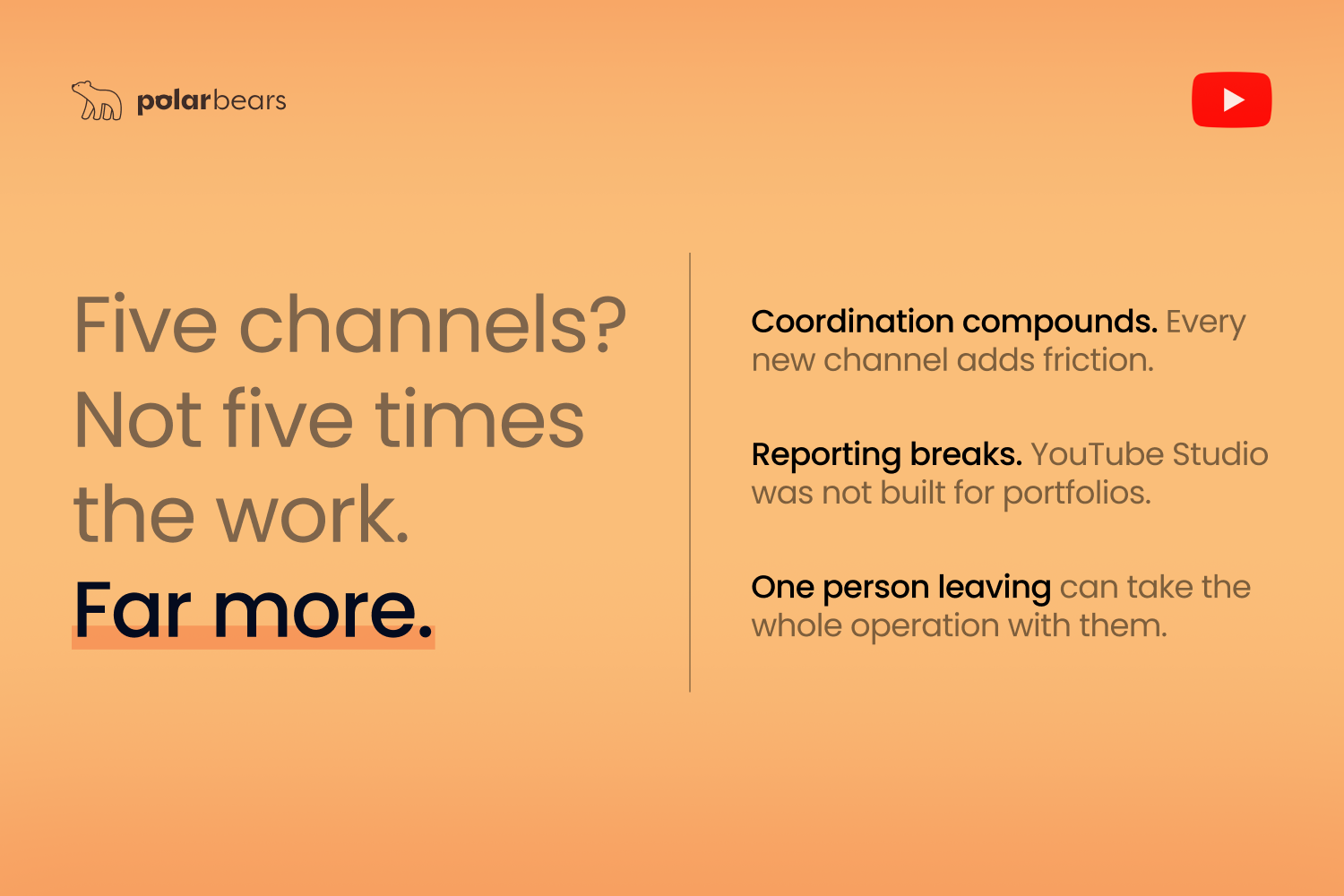
This kind of operation is very different from running one or two channels. The work does not grow at the same speed as the channel count. Five channels do not need 5 times the work of one. They need closer to 10 to 15 times the work.
That is because every shared workflow, every report, and every team handoff has to be built and kept running between them.
So this guide is for the people who run that work. Heads of digital. Multi-channel managers. Ops leads at broadcasters and rights holders. Networks running one channel per show, product, or region. If your in-house workflows are starting to crack, missed uploads, broken reports, freelancers leaving, channel six breaking channel one, this guide is for you.
This post covers three things. What real multi-channel operations involve. What the costs look like in 2026. And where to draw the line between building it in-house and hiring an agency.
Why 5+ channels breaks in-house workflows
Most teams handle one or two channels with a small setup. A producer or two. A freelance editor. Someone who owns the publishing schedule. That works because one person can hold the whole plan in their head.
The break point sits between the third and the sixth channel. After that, three problems hit at once.
The first is the coordination tax. Every new channel adds new things to track. New brand voice rules. New audience needs. New rights restrictions. Channel six does not just add its own work. It adds friction to every other channel too. Someone has to make sure decisions on channel one do not clash with channel three.
The second is broken reporting. YouTube Studio is built to manage one channel at a time. Looking at 5 to 20 channels through Studio means logging in and out, exporting data by hand, and stitching it into spreadsheets. Studio also has hard limits. Custom dashboards cap at 50 videos. Exports cap at 500. Both start to bite at scale.
The third is the single-point-of-failure risk. That means one weak link can take down the whole system. One person who knows the workflow leaves, and the network's knowledge walks out with them. One Google Account gets hacked, and every Brand Account linked to it can be hit. Both happen more than people admit. Both are operational debt.
Networks that run 10+ channels well treat YouTube like any other serious business function. Documented workflows. Tools that scale. Roles that do not depend on one person being in the office.
The six operational pillars of multi-channel YouTube
Multi-channel work breaks into six recurring jobs. Most failures come from one or two of these being weak.
Strategy and calendar planning.
This is deciding what gets published on which channel, in which week, with what goal. At one or two channels, a shared spreadsheet does the job. At ten channels, you need a real content calendar tool. It needs channel-specific views, conflict warnings, and weekly editorial reviews. Without one, channels start to clash. They repeat ideas. They go dark for three weeks at a time.
Optimisation at volume.
This is the work of titles, thumbnails, descriptions, tags, chapters, end screens, and cards. The mistake most networks make is treating this as a one-time job at upload. At scale, it has to be ongoing. Going back to old videos and refreshing their titles or thumbnails often brings in more views than new uploads do. But only if someone has the time to do it.
Publishing and scheduling.
Each upload has settings to get right. Premiere settings. Monetisation flags. Localisation tracks. Playlist placements. Community posts. End-screen links. Each one is small. Multiplied across 75 or more uploads a month, mistakes pile up. Reliable publishing usually means a dedicated ops person plus a checklist that cannot be skipped.
Cross-channel analytics.
This is where YouTube's own tools break down hardest. To see how a whole portfolio is doing, you need third-party tools to pull data together. Without them, every channel gets measured on its own. You cannot see which content moves viewers between channels. Reporting to your CFO turns into a manual job every two weeks.
Audience engagement and moderation.
This means comments, community tab activity, livestream chat, and brand-safety moderation. At enterprise scale, this is often a separate team. Sometimes outsourced. The volume grows in line with views. Audiences expect replies in hours, not days.
Compliance, rights, and monetisation.
This covers Content ID, territorial rights, age-restriction flags, monetisation eligibility, and brand-safety guidelines. Get this wrong on one video and you can lose monetisation on a channel. Get it wrong across a library and you can lose ad revenue across a whole portfolio for weeks.
If any of these six look thin in your current setup, that is where ops will break first.
In-house vs agency vs hybrid: real economics for 5+ channels
This is the section most teams skip past too quickly. Run the maths properly and the answer often surprises people.
In-house build
A 5-channel in-house team usually needs five people at minimum. A Head of YouTube or Digital. Two Channel Managers. Two Editors. Plus access to a junior analyst.
UK salary data backs this up. Glassdoor data from March 2026, based on 141 submitted salaries, puts the median YouTube Channel Manager salary at £51,418. The typical range is £40,274 to £66,126.
Add head-of-function pay, editor salaries, and tools. A 5-channel in-house team usually costs £200,000 to £300,000 a year. That is before NI, pension, equipment, and office overhead. Going up to 10 channels usually doubles that.
Specialist agency
Agency pricing for multi-channel work depends on scope. TPB's distribution packages start at £1,100 a month for around 15 videos. The pricing uses credits. That means you buy credits in bulk and spend them per video based on priority. You do not lock into a fixed retainer.
Multi-channel work scales from there. Most enterprise agency deals for 5–20 channels fall between £50,000 and £200,000 a year. That is much cheaper than building the same team in-house.
Hybrid model
This is a senior in-house lead handling strategy, with an agency handling the daily execution. It is common at media companies that want to keep editorial control but do not want to hire full-time ops staff. Annual cost is usually £100,000 to £200,000 for 5 channels.
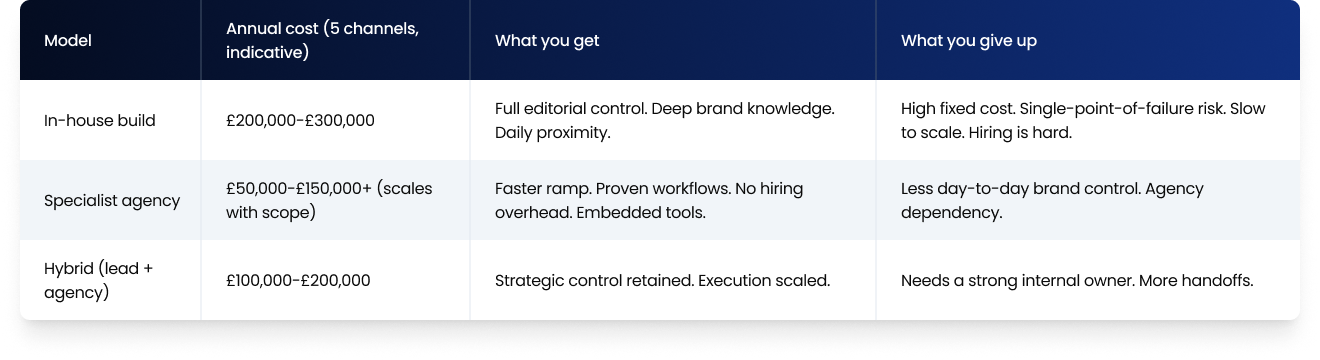
The right answer depends on three things. How many channels you run. How different each channel's voice is. And whether you can hire and keep YouTube ops staff in-house.
The third factor breaks most in-house plans. Channel-side talent is hard to recruit and harder to keep. The same skills can earn 30–40% more freelancing or running their own channel.
For more detail on what an agency engagement actually covers, see what a YouTube agency does. For a deeper look at pricing, see how channel management costs are priced in 2026.
The tooling stack for multi-channel YouTube operations
Most multi-channel networks use 6 to 10 tools. The minimum useful stack covers four jobs.
YouTube-native tools. Brand Accounts plus YouTube Studio are the foundation. A Brand Account is a special account type that lets multiple people manage one channel without sharing a password. Google confirms one Google Account can manage up to 100 channels through Brand Accounts. For partner-tier operators, YouTube also has the Content Management System which adds Content ID, bulk uploads, and rights enforcement.
Multi-channel platforms. TubeBuddy Enterprise and VidIQ both offer multi-channel views, bulk metadata editing, and cross-channel analytics. Pricing scales with the number of seats and channels.
Workflow and project management. ClickUp, Asana, and Notion are the three most-used tools for coordinating multi-channel teams. They handle editorial calendars, approvals, and asset handoffs. Without one of these, teams default to email and Slack threads. Things fall through gaps.
Performance intelligence. This is where YouTube Studio breaks down hardest at scale. The 50-video dashboard cap and 500-video export cap are blocking once a portfolio has thousands of videos. Vixxi, the YouTube intelligence platform The Polar Bears use, pulls data from YouTube, Google Ads, and Google Ad Manager into one view. It includes custom fields and true RPM reporting combining all three revenue sources into one number.
Where multi-channel operations typically fail
Five failures show up over and over across broadcasters, rights holders, and networks running multiple channels.
Brand voice drift. Every new channel tempts teams to copy the workflow from channel one. The result is uniform output that does not match each channel's audience. Channels then plateau. They are not really serving different viewers, just publishing similar content under different banners.
Broken reporting. Every channel measured on its own gives no portfolio view. The CFO sees one channel growing 30% and another flat. They reallocate budget. They miss that the flat channel sends subscribers to the growing one.
Talent churn destroying tribal knowledge. The person who set up the workflows leaves. Three months later, nobody knows why a particular tagging convention exists. The fix is documentation. Almost no one does it well.
Single-account compromise. One phishing email targeting one Google Account manager can hit every Brand Account linked to that account. The fix is simple. Hardware-key 2FA on every owner and manager account. Isolated browser profiles. Never share logins. Almost no one does this until after an incident.
Treating different YouTube formats as one workstream. Long-form video, Shorts, podcasts, and livestreams have decoupled in the algorithm over the past 18 months. Networks that still treat them as one pipeline see all four underperform.
How to know if you are ready to bring in external help
Five honest signals that the in-house build is no longer the right answer.
You publish more than 50 videos a month across the portfolio and weekly upload volume is starting to slip. You have hired and lost two or more YouTube ops people in the past 18 months. You cannot get a portfolio-level performance view without manual spreadsheet work. Your ops team is spending more time coordinating than optimising. New channel launches take three months instead of three weeks because nothing is documented.
If two or more of those apply, an agency or hybrid model usually pays for itself within a year.
The honest framing for most networks sitting on 5+ channels is this. Scale is not a tooling problem. It is not a strategy problem either. It is an operations problem. Get the operations right and the rest compounds. Get them wrong and even great content sits unwatched in a back catalogue nobody is looking after.
FAQ
How many YouTube channels can you manage from one Google Account?
Google confirms you can manage up to 100 channels from one Google Account through Brand Accounts. Most multi-channel operators spread their channels across several Google Accounts to reduce the risk of one account going down and taking everything with it.
What is YouTube channel management at scale?
YouTube channel management at scale is the operational work of running five or more active channels under shared workflows. It covers strategy, optimisation, publishing, analytics, audience engagement, and rights management. Five channels usually need 10 to 15 times the workflow complexity of one.
How much does it cost to manage multiple YouTube channels?
A 5-channel in-house team typically costs £200,000 to £300,000 a year in UK salaries before tools and overhead. Specialist agency engagements for 5+ channels usually fall between £50,000 and £200,000 a year depending on scope. The Polar Bears distribution packages start at £1,100 a month with credit-based scaling. Hybrid models sit between the two.
Should I build YouTube operations in-house or hire an agency?
The decision comes down to three things. Channel count. How distinct each channel's editorial voice is. And whether you can hire and keep YouTube ops staff. In-house works when channels share editorial voice and you have an internal talent pipeline. An agency works when speed-to-scale and consistency matter more than daily proximity. Hybrid suits most networks and rights holders running 5 to 20 channels.
What tools do you need to manage 5+ YouTube channels?
The minimum stack covers four layers. YouTube-native tools including Brand Accounts, YouTube Studio, and CMS for partners. Multi-channel platforms such as Vixxi, TubeBuddy Enterprise and VidIQ. Workflow management tools like ClickUp, Asana, or Notion. And performance intelligence tools such as Vixxi for portfolios beyond 1,000 videos where YouTube Studio's 500-video export cap becomes blocking.
How do you handle copyright and content overlap across multiple channels?
Use Content ID through YouTube's CMS for verified rights holders. Run brand-safety reviews channel by channel. Document territorial rights restrictions at the video level, not the channel level. The most common mistake is treating rights as a channel-wide policy. Restrictions usually live at the individual video level.
How do you measure success across multiple YouTube channels?
Use portfolio-level metrics not channel-level ones. Total watch time growth across the portfolio. Click-through rate trends. Library activation rate, the percentage of back-catalogue videos that earned views in the last 30 days. And revenue per thousand views combining YouTube and Google Ad Manager. Vanity metrics like total subscribers across channels are less useful than they look at scale.
Want to talk through your YouTube operations setup?
If you liked that why not take a look

Copyright Claims vs Strikes: What Brands and Broadcasters Need to Know
Copyright claims and strikes are not the same thing. What each does to your channel, when to dispute, and how brands manage copyright risk at scale.
YouTube Content ID Explained: How Rights Holders Protect and Monetise Their IP
What YouTube Content ID is, who gets access, and how rights holders use it to protect and monetise content. Payouts, policies and pitfalls explained.
What Security and Compliance Should a YouTube Agency Have?
Your agency holds your accounts and data. What SOC 2, ISO 27001, GDPR and Cyber Essentials actually mean, and what to ask before you sign.
Should Your YouTube Agency Work With Your Competitors?
Your agency might run your rival's channel too. Why agency conflict of interest matters, how good agencies keep competing clients apart, and what to ask.
What Should a YouTube Agency Put in Writing?
Most YouTube agencies dodge written commitments. What a good agency should promise: response times, reporting cadence, and fixing underperforming videos.
What Data Can You Take When You Leave a YouTube Agency?
Can you take your analytics, dashboards and custom reports when you leave a YouTube agency? What data is yours, what is not, and how to avoid lock-in.

Ready to maximise your YouTube revenue?
Get in touch and let’s begin exploring your channel’s hidden potential.